D’oh
[youtube]http://www.youtube.com/watch?v=DzrAht2Ob1o[/youtube]

[youtube]http://www.youtube.com/watch?v=DzrAht2Ob1o[/youtube]
The State Department announced at the end of last week that it plans to undertake a ‘Quadrennial Diplomacy and Development Review’, the rationale being that,
Our success in exercising effective global leadership depends upon a robust and effective State Department and USAID working side-by-side with a strong military. By using all the tools of American power, we can pave the way for shared peace, progress and prosperity. This comprehensive approach is the essence of smart power.
The final report will lay out:
The baseline: An assessment of (1) the range of global threats, challenges and opportunities both today and over the next two decades that should inform our diplomatic and development strategies; and (2) the current status of our approaches to diplomacy and development, with emphasis on the relationship between diplomacy and development in our existing policies and structures.
The ends: A clear statement of our overarching foreign policy and development objectives, our specific policy priorities, and our expected results, with an emphasis on the achievable and not merely the desirable.
The ways: A set of recommendations on the strategies needed to achieve these results, including the timing and sequencing of decisions and implementation.
The means: A set of recommendations on (1) the tools and resources needed to implement the strategy; and (2) management and organizational reforms that will improve outcomes and efficiency.
The metrics: A set of recommendations on performance measures to assess outcomes, and–where feasible–impacts.
The links: An assessment of how the results and recommendations of this review fit into broader interagency, whole-of-government approaches, and into the Administration’s larger foreign policy framework.
The review will be led by Deputy Secretary for Management and Resources Jacob Lew, and co-chaired by Director of Policy Planning Anne-Marie Slaughter and by the Administrator of USAID (still to be appointed). All this is of course very much in keeping with recent National Security Council reforms that set up a new Global Engagement Directorate tasked with driving “comprehensive engagement policies that leverage diplomacy, communications, international development and assistance, and domestic engagement and outreach”.
It also raises the question: why can’t we have a similarly integrated strategy process in the UK? DFID’s just done a White Paper; the Ministry of Defence has announced a strategic defence review; FCO revised its strategic priorities last February; but at what point do all of these get melded together into a coherent overall strategy? Surprise: they don’t.
David and I argued two years ago that the UK government needed to undertake an overall global issues strategy – a goal that remains as distant as ever, it seems…
[youtube]http://www.youtube.com/watch?v=aMyOidMq2hY[/youtube]
[youtube]http://www.youtube.com/watch?v=1ds0ppu791w[/youtube]
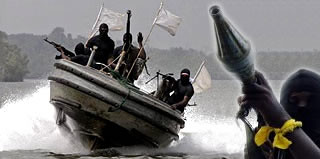
The last two weeks have seen a storm of insurgent activity in Nigeria: Shell’s onshore output has been halved to around 140,000 barrels a day, Chevron has lost about the same again (taking the aggregate output lost to over to a fifth of Nigeria’s total) – and for the first time Lagos has been attacked. According to Africasia.com,
Fighters from the Movement for the Emancipation of the Niger Delta (MEND) attacked the facility, the first strike in Nigeria’s economic nerve centre since the oil insurgency was launched in 2006. Rescuers said five people were burnt beyond recognition in the blast.
“The militants went into open shooting with the naval officers guarding the facility but they were overpowered. They used dynamite to destroy the manifold,” said Geofrey Boukoru, a member of the emergency rescue team.
The militants arrived in four speed boats, exchanging fire sporadically with the navy for about three hours before hurling dynamite into the facility, said a senior official from the Pipelines and Products Marketing Company, an affiliate of the state-run petroleum corporation.
The Lagos attack took place just before the federal government’s planned amnesty release of Henry Okah, the head of MEND – a release that, in the event, still went ahead despite the attack. MEND has since said in a statement that it “considers this release as a step towards genuine peace and prosperity if Nigeria is open to frank talks and deals sincerely with the root issues once and for all” – although as Abubakar Momoh of Lagos State University observes to AlJazeera, “What the government has done in the case of Okah is like treating the symptom and not curing the disease … there are issues that drove the militants to the trenches. Until those issues are resolved in a fair and just manner, there will never be peace in the Niger Delta.”
As David noted back in November last year, counter-insurgency expert John Robb has called Henry Okah “one of the most important people alive today, a brilliant innovator in warfare”. Here’s Robb’s account of how Okah did it. (more…)