How to blog, courtesy of the USAF
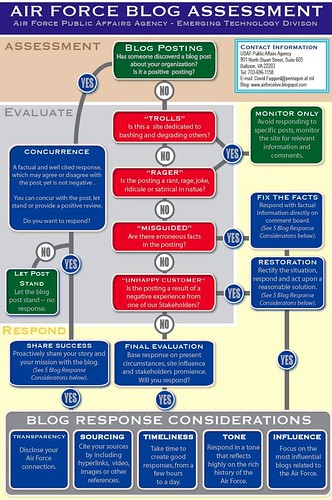
Full size version here. H/t Jeremiah Owyang, via Tom Watson.

Full size version here. H/t Jeremiah Owyang, via Tom Watson.
Retired Navy Admiral and former commander of U.S. Pacific forces, Dennis C Blair, has reportedly been chosen as Barack Obama’s next Director of National Intelligence (DNI), the country’s senior intelligence job.

Blair, a 6th generation, Oxford-educated naval officer, occupies a number of teaching posts and once served as the first associate director of CIA for military support. He also ran the federally-funded Institute for Defense Analysis before being forced out after a conflict of interest dispute.
But it is his role as the Deputy Director of the Project on National Security Reform, a bi-partisan, Congressionally-funded reform initiative, that may say most about how, if confirmed, Blair intends to manage the U.S intelligence community. For despite the misgiving of some like Bob Baer, the former CIA analyst, Blair is both a manager and a reformer.
During my time in Washington, DC, I spent a little time with Blair, who struck me as a reformer with deep insights into how both soldiers and spies work and think. See this clip where he argues that the U.S government needs to work on the basis of “integrated, agile, collaborative, inter-agency teams” rather than the departmental stove-pipes currently in existence. Not the sound of a status-quo thinker.
Being reform-minded, however, will only go so far. Blair will need to will reform, demand reform, and pursue reform. For most intelligence-watchers believe that the Bush administration’s post 9/11 intelligence reforms were hurried and have created as many problems as they have solved. The current spy chief, Admiral Mike McConnell has done what he could to improve the situation, launching a 100-day initiative when he took over from John Negroponte, to improve “integration and collaboration” across the many intelligence agencies. Meanwhile Robert Gates has scaled down the Pentagon’s footprint on intelligence.
Yet most people believe the situation needs to improve further if the U.S is to get more for the $43 billion it spends annually on intelligence. The Office of the Director of National Intelligence has become a large bureaucratic contraption with hundreds of personnel camped out in a Washington airbase. Many staff are unclear about their roles vis-à-vis their CIA colleagues.
The DNI himself, though he briefs the president daily, has only limited authority over the 16 agencies in the intelligence community as the reform legislation did not give the spy chief the kind of budgetary muscle needed to lead the intelligence community. In spite of the efforts of Gates and McConnell the National Security Agency, the National Geospatial-Intelligence Agency and the National Reconnaissance Office remain under Pentagon’s command.
Then there is the question of domestic intelligence. Many believe the U.S should create a domestic intelligence agency like Britain’s Security Service. But how to do so and avoid adding complexity to the intelligence system, slowing down rather than promoting information flows among the existing agencies, while respecting civil liberties? And who would run such an agency – the DNI, the Homeland Security Secretary, the FBI, the CIA?
Finally, there is a need to look again at Congress’ role. Oversight has deteriorated amid battles between different committees. The President’s Foreign Intelligence Advisory Board and the Intelligence Oversight Board have also atrophied in the last eight years while the Bush administration failed to create a Civil Liberties Board, despite being mandated to do so by Congress.
Blair seems well-placed to lead a reform process without allowing it to descend into something like the Church Committee hearings, which investigated intelligence-gathering by the CIA and FBI after the Watergate affair, but ended up encouraging many of the intelligence community’s bad traits. No doubt his confirmation process will drag up the conflict-of-interest case that forced him out of his last government-funded job, as well as his controversial role in opening diplomatic ties with Suharto’s Indonesia.
But the real question is: how ambitious will Obama be in leading changes in Congress; and reforms in the Executive Branch to ensure a well-functioning intelligence apparatus that can deal with foreign and domestic threats, produce politically-neutral assessments, work with other government departments and guarantee civil liberties. Obama’s choice of Blair shows the President Elect wants to reform, but also wants to keep the intelligence community on board.

From a special report in The Economist:
With just over a couple of weeks to the inauguration, it’s finally sinking in: Barack Obama’s Presidency is going to imply some pretty fundamental changes to the global war on terror. Serious thinking on how to dismantle Guantanamo is well underway – as is discussion about which of America’s allies will be willing to welcome its detainees (Australia and Britain both profess reluctance; Portugal, on the other hand, looks well on course for a special relationship with the new Administration). A sea change on torture and rendition also appears to be a racing certainty.
In Iraq, too, massive changes are underway. As well as the rich symbolism of the sock and awe incident, there’s now also yesterday’s more tangible proof of how far things have moved on: the Iraqi government has assumed control of the Green Zone.
Now, pause to wonder: are these changes likely to have a significant impact on the capacity of radical Islamist groups to recruit and retain committed volunteers – whether in Europe, the Middle East, South Asia or wherever? After all, Guantanamo, torture, rendition and Iraq surely represented four of the principal sources of the sense of grievance so essential to effective radicalisation. Does that mean the outlook on counter-terrorism is finally brightening?
One possible reason why not, of course, has to do with Gaza. Olmert’s rationale for Israel’s attacks is not hard to discern – Hamas ended its ceasefire, there’s an election in February, he wanted to rebuild Israel’s credibility after the 2006 debacle in Lebanon, there was only a brief window of opportunity before Obama’s inauguration. But even so, the fact that Israel’s attacks have so far killed 436 Palestinians (compared to 172 dead in Mumbai) will clearly fuel a sense of outrage among many – including this blogger – and will provide a powerful recruiting sergeant for Islamist groups everywhere.
But another answer to the question of sources of grievance after Bush can be found by taking a stroll down my local high street, in a part of East London that has one of the highest proportions of Muslims in the capital.
Today, the activist posters you see on lamposts and on the walls of the shops selling mobile phone skins and international calling cards have one key message: end the undeclared war on Pakistan. If you visit Hizb ut-Tahrir’s website, meanwhile, you find that just beneath the coverage of Gaza from the last fortnight, it’s Pakistan that’s the focus of attention and grievance – a point made even clearer by this youtube video of theirs from the start of December.
[youtube:http://uk.youtube.com/watch?v=uI47aQVLoq0]
You might think it odd that Islamist opinion in the UK should be focusing on a relatively small number of drone attacks in Pakistan when a major troop surge is about to take place over the border in Afghanistan. But think again, and you realise that of course it makes eminent sense for Hizb ut-Tahrir to focus on the grievance of most direct relevance to Britain’s large diaspora community – and to weave political Islamism into long-standing fears about Pakistan’s territorial integrity.
Barack Obama’s arrival in the White House represents a welcome turning point on many components of the ‘war on terror’. But the evolving situation in Pakistan (on which Obama is hawkish, remember) may well represent another – especially here in the UK. If Obama steps up US attacks on Pakistan’s border areas, then many British Muslims will doubtless listen to what Gordon Brown has to say about it with keen interest…