The moment healthcare passed the House
[youtube]http://www.youtube.com/watch?v=iOQ-Iw6_wTA[/youtube]

[youtube]http://www.youtube.com/watch?v=iOQ-Iw6_wTA[/youtube]
Wow, who says democracy is dead? The nay-sayers should check out this incredible debate on the crucial issue of the day – climate change – which happened on November 5 in 2009. And like that famous day 404 years ago, the debate threatened to blow the roof off parliament!
Well, er, not quite. In fact, the video which the BBC’s Democracy Live website has helpfully put up begins with a surreal three minutes of mind-crushing banality, in which the Speaker goes through a list of 20 questions and asks of each one, ‘Debate to be resumed on which day?’, at which a grey-haired lady stands up and says ‘Thursday week, Mr Speaker’, and so on, and on, and on.
Finally, Ed Miliband stands up and we get the big debate on what the UK is going to do to help developing countries cope with climate change, and the combined members of the House – all fifteen of them – engage in half an hour or so of completely dismal and uninterested debate. Electrifying.
‘Call it the power of inevitability’, scroll the white letters on a black background, as a woman wails in Islamic fervour. ‘You know you have to be here.’ Cut to a speedboat racing across the bay towards a mighty skyscraper. ‘Believing is seeing’, flash the white letters. A sports car approaches the skyscraper, and a dapper figure climbs out. It’s…it’s Tyler Brûlé!
No, it’s the latest advert for the Trump Tower in Dubai, one of the many vanity real estate projects announced in the boom years, that have now hit the rocks. ‘The thrill that every whim will soon become a reality’, the advert coos. Well, maybe not that soon. Local developer Nakheel, owned by the Dubai emirate, is struggling to pay back its $10bn in debt, and may have to be bailed out by the UAE government. Its Palm Deira and Waterfront projects, once planned to be bigger than Hong Kong, have also been delayed.
So too has the Pad, a high-tech residential complex built by Omniyat, in which each apartment would be ‘intelligent’, which means, apparently, it would monitor residents’ body temperatures and their taste in entertainment, so your apartment would know when you bring back a girl, and would intelligently turn up the temperature, dim the lights, and play Barry Manilow. Alas, the developers proved slightly less intelligent than the apartments, and the project has been delayed.
So many new properties are coming onto the market in the next two years, that Nomura estimates 150,000 jobs would need to be created to fill all the new office space. Alas, the trend is going the other way – Jones Lang La Salle estimates the population of Dubai will fall 10% this year.
Still, analysts are optimistic that Dubai will remain the main financial and trading hub for the Middle East, despite the best efforts of Riyadh, Doha, Beirut and Manama to challenge it. There’s no booze in Riyadh, Doha is incredibly boring, Manama is even less financially transparent, and Beirut is constantly being dragged to war by Hesbollah.
So the Biblical prophecies of the collapse of Dubai are unlikely to come true in the near future, much to the disappointment of Simon Jenkins, who started foaming at the mouth at the prospect earlier this year:
This off-the-shelf city state has been built on laundering the profits of oil, drugs, arms and western aid, he raved [western aid? shurely not]..the towers of Dubai will become casualties not of human greed but of architectural folly. Their lifts and services, expensive to maintain, will collapse. Their colossal facades will shed glass. Sand will drift round their trunkless legs. Animals will inhabit their basements.
Thousands of residential properties, if occupied at all, will be squatted by a migratory poor, like the hotel towers of the Spanish littoral or Corbusier’s blockhouses of Chandigarh in India. Refugees will colonise the camps where Indian workers have lived as they built Dubai. Gangs will seize the gated estates and random anarchy will rule the soulless boulevards.
If it is lucky Dubai will at least be a refuge from the political cataclysms that could engulf countries such as Pakistan, Iran, Iraq and Saudi Arabia. But mostly the dunes will reclaim the place. In centuries to come, tourists will share with Ozymandias the message: “Look on my works ye mighty and despair.’” With Shelley they will see how, “round the decay /Of that colossal wreck, boundless and bare /The lone and level sands stretch far away.”
Not a big traveller, are you Simon?
– The former British Governor of Hong Kong, Chris Patten, explains why he’s not grumpy about the current state of international politics – perhaps an outside candidate for the role of EU Foreign Minister? Le Monde diplomatique, meanwhile, suggests that the path to Lisbon has emphasised the gap between European governments and their citizens.
– John Gapper takes a look at Warren Buffett’s $27 billion deal to buy the railroad company BNSF, and explores what the “Sage of Omaha’s” latest move says about the basis of US economic recovery. Harold James, meanwhile, assesses the current state of monetary policy following the financial crisis, suggesting that we may be heading towards “international monetary chaos”.
– Elsewhere, the Daily Beast reproduces the “lost” victory and concession speeches that Sarah Palin never gave on election night one year ago – making for interesting reading indeed.
– Finally, over at Oxfam, Duncan Green laments the familiar refrain of NGOs, international institutions and governments alike to the need for “political will” and “good governance” when trying to achieve reform. Greater investment in “political literacy” and deeper “power analysis” instead, he suggests, should underpin attempts to bring about such change.
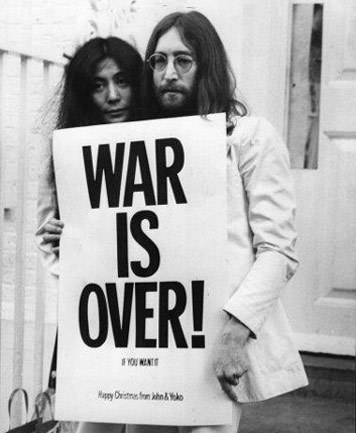
NEW YORK, Nov. 3 /PRNewswire/ — To celebrate the unifying spirit and 40th anniversary of the Plastic Ono Band’s universal anthem, “Give Peace a Chance,” Yoko Ono, Sean Lennon and Julian Lennon have partnered with EMI Music and Sony/ATV Music Publishing to donate net proceeds from the sale of a commemorative 40th Anniversary digital single to the United Nations Peacebuilding Fund (PBF). Beginning today, iTunes will exclusively offer the single’s special anniversary edition for download purchase, with net proceeds benefiting the PBF through December 31.
Says Yoko Ono, “I am thrilled that so many in the music business are readily supporting ‘Give Peace a Chance’ on its 40th anniversary. It is indeed a time when we are all getting more aware of the necessity of doing something to achieve world peace, no matter how small. Thank you, thank you, thank you. I feel deeply that we are all one, regardless of where we stand.”
“I am delighted to see that a song so closely identified with the pursuit of peace, will shine a light on the United Nations’ peacebuilding efforts and financially support PBF projects,” the Chairperson of the United Nations Peacebuilding Commission (PBC), Ambassador Heraldo Munoz of Chile said.
Thank you, Yoko (thrice over). Just in case any pop pickers are not fully informed about the groovy activities of the PBC, the press release explains:
The PBC and the PBF were established after the 2005 World Summit to create mechanisms to assist national authorities in post-conflict countries build sustainable peace. The PBC is an intergovernmental body that brings together relevant actors, including donors, Member States, international financial institutions (such as the World Bank) and national governments. By creating this broad platform, the PBC plays a key role in ensuring that the international community can assist countries emerging from conflict to achieve sustainable peace in a coordinated manner.
So, not to be confused with the artiste’s Peace Tower, a beam of light that shines over Rekjavik every year to commemorate John Lennon’s death:

Imagine all the people, coordinating life in sustainable peace…