MEND leader Henry Okah released
[youtube]http://www.youtube.com/watch?v=1ds0ppu791w[/youtube]

[youtube]http://www.youtube.com/watch?v=1ds0ppu791w[/youtube]
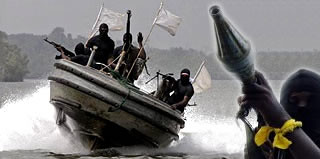
The last two weeks have seen a storm of insurgent activity in Nigeria: Shell’s onshore output has been halved to around 140,000 barrels a day, Chevron has lost about the same again (taking the aggregate output lost to over to a fifth of Nigeria’s total) – and for the first time Lagos has been attacked. According to Africasia.com,
Fighters from the Movement for the Emancipation of the Niger Delta (MEND) attacked the facility, the first strike in Nigeria’s economic nerve centre since the oil insurgency was launched in 2006. Rescuers said five people were burnt beyond recognition in the blast.
“The militants went into open shooting with the naval officers guarding the facility but they were overpowered. They used dynamite to destroy the manifold,” said Geofrey Boukoru, a member of the emergency rescue team.
The militants arrived in four speed boats, exchanging fire sporadically with the navy for about three hours before hurling dynamite into the facility, said a senior official from the Pipelines and Products Marketing Company, an affiliate of the state-run petroleum corporation.
The Lagos attack took place just before the federal government’s planned amnesty release of Henry Okah, the head of MEND – a release that, in the event, still went ahead despite the attack. MEND has since said in a statement that it “considers this release as a step towards genuine peace and prosperity if Nigeria is open to frank talks and deals sincerely with the root issues once and for all” – although as Abubakar Momoh of Lagos State University observes to AlJazeera, “What the government has done in the case of Okah is like treating the symptom and not curing the disease … there are issues that drove the militants to the trenches. Until those issues are resolved in a fair and just manner, there will never be peace in the Niger Delta.”
As David noted back in November last year, counter-insurgency expert John Robb has called Henry Okah “one of the most important people alive today, a brilliant innovator in warfare”. Here’s Robb’s account of how Okah did it. (more…)
Prospect editor David Goodhart has an intriguing idea:
Sweeping schemes for constitutional reform and global salvation abound. Not to be left out, Prospect has a plan that neatly solves two problems in one—and doesn’t even need primary legislation. The idea is this: cap the number of government members drawn from parliament at 50 (down from the current figure of 124)—and draw the remaining talent from outside. At a stroke, this would create more competition for government jobs—not a bad thing in itself—and give a boost to the parliamentary career path. With fewer government jobs to chase, more of parliament’s brightest could focus on chairing select committees, improving legislation and keeping the government in check; all of which would strengthen the legislature against an over-mighty executive.
In his chaotic June cabinet reshuffle Gordon Brown brought in a record number of lords, seen by some as an indication of a government low on steam. Much better to start afresh with a new system where genuine experts and talented non-parliamentarians could fill the vacant slots—and thus strike a blow against the professionalisation of politics, where too few MPs have experiences outside Westminster. America stuffs its executive with able non-politicians drawn from businesses and charities. And just as in the US, this new breed could fairly easily be made accountable to the legislature. So why shouldn’t we? Go on Gordon—cut the ministers, not the MPs. A genuine government of all the talents is there for the taking.
Cross-border wars in Sub-Saharan Africa have been few and far between since the end of the colonial period. Instead, the continent’s disaffected have fought numerous battles with their own countrymen. Last weekend, however, Guinea’s new leader, Dadis Camara, who took power in a coup last Christmas, claimed that neighbouring Guinea-Bissau was amassing troops at the border in preparation for an invasion of his country.
This would be a remarkable move by Guinea-Bissau, which doesn’t currently have a leader (the second round of presidential elections is due on 26 July) and whose army is a disaffected ragbag of poorly paid, badly trained young men who have enough trouble keeping the peace at home (their chief of staff was assassinated in March) without contemplating an invasion of a much bigger neighbour.
Camara reckons the planned invasion is a plot by the region’s drug lords, from Guinea, Guinea-Bissau and Latin America, to remove him. Camara has been surprisingly thorough in his purging of those Guineans involved in the cocaine trade which has plagued the countries of the Mano River basin in recent years, and he believes those high up in the industry want him out so that they can maintain their freedom to operate.
A war between the two countries would be disastrous for both and for their region. Both are extremely fragile politically, dirt poor and surrounded by other historically unstable states (Liberia, Sierra Leone, Senegal’s Casamance region). Guinea’s opposition parties are less worried, however. They see Camara’s warning as a ploy to entrench his power ahead of promised elections in October. Given that he has also banned all political and union activities in his country, it seems that a false alarm of an invasion would indeed be in keeping with a strategy to stay in power, despite his promise to step down once elections are held.

From the Wasilla Frontiersman, Sarah Palin’s hometown newspaper:
To the editor:
I am a supporter of Gov. Palin from Staten Island, N.Y., and blog exclusively about her accomplishments, an activity I find particularly uplifting and inspirational.
[Cue some stuff about N.Y. governors being rubbish. Then…]
I am compiling a master list of Gov. Palin’s 2009 accomplishments — a project that has taken several hours and is nowhere near finished. I had to build a team of authors on my blog just to cover her accomplishments. There are simply too many in volume, size, scale and scope to be covered by one person. Sarah Palin accomplished every goal set forth when she campaigned to be your state’s governor. Her staff remains and is on the same page with her. She is a textbook transformational leader — the type studied in MBA courses. She performed her service with honor, grace and to the highest of standards.
Free of gubernatorial limitations and unbound from the shackles of frivolous ethics complaints, Gov. Palin can and will accomplish even more for Alaska and for our nation. Everything she has done thus far will pale in (pun intended) comparison to what she is about to do.
Ron Devito
He’s not making it up. Check out Ron’s month-by-month breakdown of our next President’s accomplishments.