Ahmadinejad – the walk out
[youtube]http://www.youtube.com/watch?v=5hlxvMYu28Y[/youtube]

[youtube]http://www.youtube.com/watch?v=5hlxvMYu28Y[/youtube]
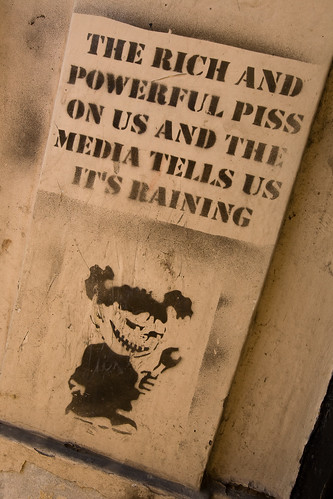
Like most of you, I spend most of my days weeping at the fate of rich. But I don’t think I’d realised how bad things were, until I came across Gabriel Sherman’s definitive account.
You should probably get your senior executive assistant to read you the whole thing, but if you’re been forced to cull the hired help, the key themes are: (i) Make sure we, the rich, are paid more than anyone else, even if we go bust. (ii) Don’t expect us to foot the bill from the bailout – tax the sheeple instead. (iii) Money isn’t enough – we demand deference and respect.
Here are some of the quotes that made me tear up:
Citigroup exec: “No offense to Middle America, but if someone went to Columbia or Wharton, [even if] their company is a fumbling, mismanaged bank, why should they all of a sudden be paid the same as the guy down the block who delivers restaurant supplies for Sysco out of a huge, shiny truck?”
Bankrupt Wall Street exec: “I think [Obama] doesn’t have an appreciation for how hard it is to build these companies, the blood, sweat, and tears that goes into them. It’s just that he has no passion for it.”
Bear Stearns senior managing director: “Honestly, you can pick on Wall Street all you want, I don’t think it’s fair. It’s fair to say you ran your companies into the ground, your risk management is flawed-that is perfectly legitimate. You can lay criticism on GM or others. But I don’t think it’s fair to say Wall Street is paid too much.”
Wall Street exec: “Why are [we] being punished for making a lot of money?”
Hedge fund guy: “The government wants me to be a slave!”
Another hedge fund guy: “JPMorgan and all these guys should go on strike—see what happens to the country without Wall Street.”
I’d also highly recommend reading the Economist’s typically incisive analysis. The stakes are high, it warns. Raise taxes on the rich and you’re on a slippery slope towards fascism, genocide and global conflict:
Barack Obama has suggested raising the tax rates on high earners and closing loopholes such as the carried-interest privilege enjoyed by private-equity managers. Such tax changes may suit the public mood. The danger is that popular anger, once released, can fasten on targets beyond the rich; immigrants, say, or foreigners generally. The 1930s Depression led to fascism in Germany and the second world war. Even if such apocalypses are avoided, the anti-rich backlash can [still] go too far.
So, repeat after me, “They came first for the rich, and I didn’t speak up because I wasn’t rich. Then they came for the Jews…”
The smeargate story rumbles on, though the reporting on it is patchy. I thought the Evening Standard, on Tuesday evening, got right to the heart of it, pointing out the key points: particularly that Brown invited Derek Draper for lunch at Chequers the week after Draper had set up the Red Rag website, so the idea this was all going on without Brown’s knowledge is not tenable.
Guido Fawkes, the Tory hero of the hour, has a hilarious diary in this week’s Spectator, recounting his week, including him sending a quote from the film Conan the Barbarian to McBride the day that the story exploded: ‘What is best in life? To crush your enemies, see them driven before you, and to hear the lamentation of their women’, then his wife ticking him off, saying ‘why would you do that? You might put us in danger – These are powerful people.’
I like the sound of Guido. Anyone who ran illegal acid house raves in the late eighties is alright by me. One of the slurs put about by McBride, by the way, is that Osborne raved it up at Guido’s warehouse dos. That would win my vote.
He’s also a cunning little fella. He did a politics show debate with Derek Draper back in late March, and first of all, he wore a Berkeley Univ. t-shirt, which he now admits was a wind-up of Draper, who claimed to have studied psychology at the Wright Institute in Berkeley, which implies the institute is at Berkeley University – it’s not, it’s just in the town.
And he stitched Draper up in that show, getting him to deny he was fed stories by Damian McBride, when in fact Guido already had the emails in his possession, so knew that Draper had just lied on TV. Sly.
Martin Bright, in the Spectator’s Coffee House blog, also makes a very good point:
The Prime Minister’s belated apology suggests that he now knows how toxic this has become. He is right to be angry because McBride has put his government at the mercy of a maverick right-wing libertarian blogger. Quite why he and the people around him became quite so fixated on Paul Staines (aka Guido Fawkes), is completely beyond me. But they were genuinely obsessed, that much is clear.
This is another key point, that I’ve also made. Why the hell were Labour so obsessed with Guido and Iain Dale? They weren’t columnists on the Sun. They hardly had the nation’s ear. But yet Labour big-wigs were obsessed. Hazel Blears attacked them in a speech. John Prescott warned them “we’re taking over”. Draper managed to get £100,000 in union money just to take them on.This shows how out of touch, and out of ideas, Labour have become.
It really reminds me of the Kremlin’s paranoid obsession with CIA-funded ‘colour revolutions’ in Ukraine and Georgia. The KGB, sorry, FSB, was obsessed with the idea that these revolutions weren’t genuine democratic movements, but merely CIA-funded operations (and yes the CIA did put some money in, but speak to anyone in Kiev and you’ll know these were also genuine democratic protests), so the FSB then spent hundreds of millions on their own fake democratic youth movements, like the carefully-orchestrated and amply funded youth movement, Nashi.
LabourList is the blog equivalent of Nashi – it pretends to be grass roots, but is really state-sponsored astro-turf.
This brings me to another question. If blogs become the front-line of party political battles, then will we start having proxy wars via the blogs, with leading bloggers acting, in effect, like Hezbollah, as the guerrila covers for covert party actions against each other? That. I guess, is what Red Rag was intended to be.
Anyway, the thing that most struck me about the scandal is that it is, IMHO, the first big political scandal we have seen unfold in front of our eyes, on blogs and on Twitter, and then roll down from the hills onto TV news and the newspapers. It has been an interactive scandal, dare I say it, a fun scandal, and that is in great part thanks to Fawkes and Dale. So yes, lots of talk about how the scandal has brought down the level of politics, but I think in some ways it has raised it, from the citizen’s point of view. We are all Wooodward and Bernstein now.
Russia is now demanding that NATO halt its planned military exercises in Georgia. On a visit to Armenia, Russian Foreign Minister Sergei Lavrov warned that the planned NATO exercises risk further undermining stability in the troubled Caucasus region. That is a bit rich, given that Moscow has effectively dismembered Georgia and is perpetuating the conflict by continuing to deploy forces in the region.
But what should NATO do? There is obviously no point in undermining the emerging détente between the US and Russia, promoted by the Obama administration. Yet at the same time, the thaw in relations should not allow Russia to play its bullyboy games. I told a journalist today:
The new relations could oblige NATO to reconsider the exercises in Georgia, as long as this is done not just to please Russia but because we are rethinking how to engage Russia and Geogia.
It is worth elaborating a little on this. The strategic context has clearly changed and NATO probably needs to appreciate this. The alliance cannot afford to be out of synch with its largest stakeholder. NATO’s Russia policy cannot be about Georgia alone, just as the West’s China policy cannot only be about Tibet. But any review of policy must not be seen as bowing to Russian pressure or stepping away from NATO’s “open door” policy – which welcomes new, peaceful democratic members if they wish to join.
William Lind is (along with Martin van Creveld) the godfather of fourth generation warfare theory, so it’s worth sitting up straight when he publishes his 300th On War column and decides to distil the lessons of the previous 299 columns down into three points. Here they are, together with his conclusion:
- So long as America pursues an offensive grand strategy, Fourth Generation war will ensure her defeat. The reason is Martin van Creveld’s concept of the power of weakness and its intimate relationship with legitimacy. In a Fourth Generation world, legitimacy is the coin of the realm. At root, Fourth Generation war is a contest for legitimacy between the state and a wide variety of non-state primary loyalties. American power lacks legitimacy because, on the physical level, it is so overwhelming. That is the power of weakness: anyone who stands up to the American military becomes a hero. In turn, any state the American military supports loses its legitimacy. The more places America intervenes militarily, the more states lose their legitimacy, to the advantage of Fourth Generation, non-state entities. In effect, we have a reverse Midas touch. Only a defensive grand strategy, where we mind our own business and leave other states to mind theirs, can break us out of this downward spiral.
- Second Generation militaries cannot win Fourth Generation wars. Second Generation armed forces, such as those of the United States, fight by putting firepower on targets. This wins at the physical level, but as it does so it brings defeat at the moral level, which is decisive in 4GW. The best current example is Pakistan, where the combination of Predator strikes and arm-twisting of the Pakistani government has undermined the legitimacy of the Pakistani state. That state now stands on the verge of disintegration, which would give al Qaeda and other Islamic 4GW forces the greatest victory they could imagine. The image on Osama’s cave wall should be a Predator, with the title, “Our best weapon.”
- There is no chance America will adopt a defensive grand strategy or reform its military to move from the Second to the Third Generation – a necessary though not sufficient step in confronting 4GW – so long as the current Washington Establishment remains in power. That Establishment is drunk on hubris, cut off from the world beyond court politics and thoroughly corrupted by Pentagon “business as usual,” which knows how to buy whatever political support it needs. Like all establishments, it sees any real change as a threat, to be avoided. So long as it reigns, nothing will change.
What are the implications of these three observations? Militarily, they portend continued failure and defeat. We will fail to get out of Iraq before the next phase of that war begins, or, worse, an Israeli attack on Iran costs us the army we have in Iraq. We will be defeated in Afghanistan, because we will refuse to scale our strategic objectives to what is possible and we will continue to alienate the population with our firepower-intensive way of war.
We will push Pakistan over the brink into disintegration, which will be a strategic catastrophe of the first order. We will ignore the disintegration of the state in Mexico, while importing Mexico’s disorder through our ineffective border controls. We will not even be able to stop Somali pirates. What does it say about us when the whole nation rejoices because the U.S. Navy, the most powerful navy on earth, defeated four Somali teenagers?
It does not end with this. These foreign policy failures and military defeats – or even more embarrassing “victories” – become just two of a larger series of crises, including the economic crisis (depression followed by runaway inflation), foreign exchange crisis (collapse of the dollar), political crisis (no one in the Establishment knows what to do, but the Establishment offers the voters no alternative to itself), energy crisis, etc. Together, these discrete crises snowball into a systemic crisis, which is what happens when the outside world demands greater change than the political system permits. At that point, the political system collapses and is replaced by something else. In the old days, it meant a change of dynasty. What might it mean today? My guess is a radical devolution, at the conclusion of which life is once again local.
That would be, on the whole, a happy outcome. But I fear this will be a trip where the journey is not half the fun.