by David Steven | Jan 28, 2009 | Economics and development
Courtesy Flickr user massdistraction
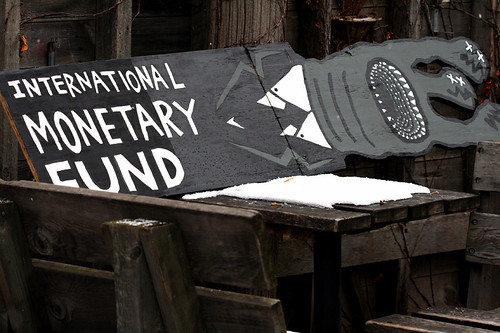
The IMF today predicted a grim economic outlook for 2009, with some green shoots in 2010.
The news is especially grim for the UK and Eurozone countries, with a 2.8% and 2% fall in output in 2009 and barely any growth in 2010. The US is predicted to do quite a lot better – a 1.6% fall this year, but 1.6% of growth next. That should cue a pleasant new wave of American triumphalism.
China floats through the crisis more or less unscathed. Growth slips to 6.7% in 2009, but bounces back to 8% in 2010. India does a little worse, Brazil suffers pretty badly, while the Mexican economy really tanks.
But I really don’t know why I even bothered to read the stats. Nine months ago at the Progressive Governance Summit, Dominique Strauss-Kahn told everyone that Europe and the US would experience a slowdown, but not a loss of growth (with the European economy expected to outperform the American one).
Even since it last ran its models in November (just three months ago!), the IMF has knocked 1.7 percentage points off world growth, and a staggering 6 points from its prediction for what were once known as the Asian tigers.
The IMF itself is forced to admit that “the uncertainty surrounding the outlook is unusually large.” Doesn’t that translate as “our models weren’t built for these crazy conditions, but we’ll run them anyway and PR them heavily to the 1000 or so media outlets that’ll reprint our speculation as fact”?
Or am I missing something here?
by Richard Gowan | Jan 28, 2009 | Climate and resource scarcity, Off topic
Alex has got a good deal of media attention for his excellent new Chatham House report on future of food crises but the Daily Telegraph got the real scoop – by making up a scare story about the death of the Sunday Roast:
Researchers at Chatham House, a think-tank, found that a recent fall in the price of butter, milk and bread was likely to be only a “temporary reprieve”.
The price hikes would hit the price of beef, pork and lamb harder because they are reared on proportionately more grain than “white meat” like chicken.
Alex Evans, the report’s author, said the likely effect would be to make Britons less reliant on beef as a core part of the nation’s diet.
“It will become more expensive,” said Mr Evans. “We are not saying people won’t be able to have a Sunday roast but we will be eating less red meat in future.”
Now, there are some kill-joys who might point out that Alex’s report doesn’t actually mention the Sunday Roast once, but Global Dashboard has an established track-record of commentary in defense of fine British food: check out Evans and Gowan on Bubble, Squeak and eels last July. But the fact that pork prices are set to sky-rocket may explain an American internet phenomenon noted by the NYT today: a BBQ recipe going viral.
This recipe is the Bacon Explosion, modestly called by its inventors “the BBQ Sausage Recipe of all Recipes.” The instructions for constructing this massive torpedo-shaped amalgamation of two pounds of bacon woven through and around two pounds of sausage and slathered in barbecue sauce first appeared last month on the Web site of a team of Kansas City competition barbecuers. They say a diverse collection of well over 16,000 Web sites have linked to the recipe, celebrating, or sometimes scolding, its excessiveness. A fresh audience could be ready to discover it on Super Bowl Sunday.
Where once homegrown recipes were disseminated in Ann Landers columns or Junior League cookbooks, new media have changed — and greatly accelerated — the path to popularity. Few recipes have cruised down this path as fast or as far as the Bacon Explosion, and this turns out to be no accident. One of its inventors works as an Internet marketer, and had a sophisticated understanding of how the latest tools of promotion could be applied to a four-pound roll of pork.
Leaving aside the new media aspect of all this, I’d argue that Americans are wisely stuffing down bacon and sausage before the prices head back up. If you want to make your own Bacon Explosion, the recipe’s here. My own urge to start layering the bacon wrapping was reduced by the discovery that the outcome looks like, well, you know…

For those more interested in making a quick buck than a Bacon Copralite (google it yourself), switch over to Porkworld, Latin America’s leading swine-trade website, which naturally features quotations from one Alex Evans…
by Jules Evans | Jan 28, 2009 | Europe and Central Asia
Last week, I saw the leader of the Hungarian opposition, Viktor Orban, call for a new central European security alliance against Russia.
Orban warned that the EU needed to take a tougher line with Russia. He said: “Russia has made two requirements that are not acceptable for European civilisation. Firstly, it has said it has legitimate security interests outside of Russia, so it can decide, for example, whether other countries can join NATO or not. That’s dangerous.”
He went on: “Secondly, Russia wants to buy out alternative sources of energy around the region, and to monopolise gas deliveries to the whole region, which is totally against our values.”
Orban said that the Russo-Georgian war of August 2008 testified to “the weakness of common EU security policy”, and added: “We in central Europe have a different approach to emerging Russian power, and it’s obvious that sooner or later, central Europe will emerge as an independent player in security.”
He also warned that Germany was playing a “dangerous game” with Russia, by not checking its expansionism more aggressively.
There’s some domestic politics going on here. Orban’s ouster in Hungary, Ferenc Gyurscany, has taken a much more conciliatory stance towards Russia and Gazprom, including supporting Gazprom’s Blue Stream pipeline over the EU-backed Nabucco pipeline. Gyurscany said he wanted Hungary to become an “energy hub” in Europe. You can practically smell the vodka on his breath.
Still, now Hungary’s economy is deep in recession, Gyurscany may be on the way out, and Orban sounds like he is likely to introduce a much tougher eastern foreign policy.
by Jules Evans | Jan 28, 2009 | Africa, Economics and development
We recently published an interview with the CEO of Actis, Paul Fletcher, in www.emeafinance.com. Actis is the emerging market private equity fund which was created in 2004 when DFID, the department for international development, privatised CDC and sold its private equity arm to the then-managers of CDC, led by Fletcher.
I thought it was quite a balanced piece, but I just got a call from them saying they no longer consider our magazine friendly and will neither cooperate or advertise with us.
Some people are so touchy. All I did was quote a report published by the National Audit Office in December, which revealed that Actis had made around £130mn in fees and carry from 2004 to 2007, purely from its main investor, DFID.
And the managers of Actis only paid £363,000 to the government when the fund was privatised from DFID in 2004. That’s a percentage growth of 30,000% in three years. Not bad!
I would have celebrated that if I was Actis. What an eye for a bargain they possess. But no, they seem to want to hide this fact from the public. Why? Just modest I guess.
by Alex Evans | Jan 28, 2009 | Influence and networks
[youtube:http://uk.youtube.com/watch?v=kica8hmSdAM&feature=related]
This video interview shows Derick Ashong, an Obama supporter, getting approached by a (presumably pro-Clinton) interviewer outside Obama and Clinton’s third debate in February last year. Here’s how the New York Times described what happened next:
“So why are you for Obama?” he asked. It was clear from his approach that he expected a dimwitted answer, an expectation that he was about to talk to another acolyte smitten by Senator Obama’s rock star persona.
But, as it turned out, Mr. Ashong, who was raised in Ghana and elsewhere, was glad to be asked. For almost six minutes — about a century in broadcast television years — Mr. Ashong, who has an immigrant’s love of democracy and the furrowed brow of a Brookings fellow, held forth on universal health care, single-payer approaches and public-private partnerships.
“A lot of these H.M.O.’s are publicly traded companies anyway, but I don’t think we want to create a market for health care per se, like we don’t want to create a futures market in health care,” he said. And so on.
Cute stuff. Highly informative. But not the kind of political discourse that generally captures a wider audience.
But here’s the weird part. On Feb. 2, the interview of Mr. Ashong was posted on a YouTube channel called “The Latest Controversy,” where supporters of both Senator Hillary Rodham Clinton and Senator Obama are asked very aggressively to justify their choice of candidates. The video blew up, drawing more than 850,000 views. And after that huge response to his policy analysis, Mr. Ashong decided to double down and explain the emotional component of his support for Obama in a follow-up video that was posted Feb. 11 and received 300,000 views.
Taken together, that means a guy who was looking to (anonymously) show a little love for a candidate was able to look into the camera for more than 13 minutes combined and draw in more than a million clicks with an impassioned but reasoned pitch.
Ashong will be in the UK next month, and speaking at a meeting of the All-Party Parliamentary Group on Conflict Issues. Details: 6.30pm on 26 February in the Grand Committee Room in Parliament. More from the NYT piece after the jump. (more…)