by Charlie Edwards | Sep 26, 2008 | North America, UK
The Hollowmen are back with a close-to-the-bone episode on terrorism. This is 27 minutes and 46 seconds of brilliance, there never has been a more important time to talk about terrorism after all. Witness a shaky Merv being sat down and told they have a major national security problem – they are under attack – from who he enquires – from terrorists? No! From the opposition and they’re out to get the PM.
Watch the episode here
As you watch this episode bear in mind the Australian Government will be publishing a national security strategy in the coming weeks. Let’s hope it reduces the myriad of inefficiencies.
Best quote: “You sack so much as one sniffer dog and the headline will be: PM soft on terror.” Genius.
by Charlie Edwards | Sep 26, 2008 | Off topic
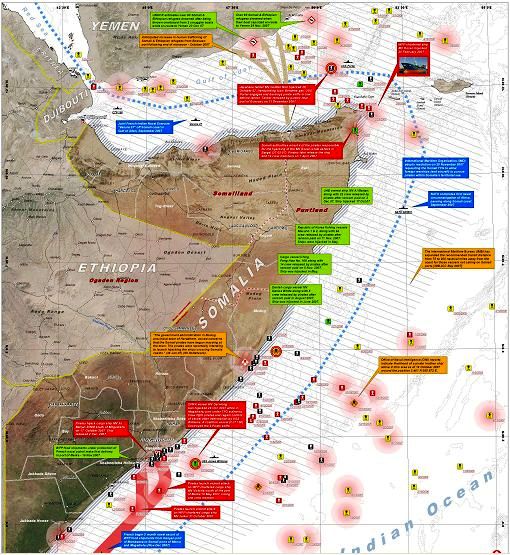
I know what you’re thinking. What are pirates going to do with 30 Russian T72 tanks? Not much probably but the rest of the cargo, a mixture of RPGs and the Zu-23 anti-aircraft guns will soon find their way into Somalia’s arms markets. The situation off the cost of Somalia is getting progressively worse. And while we will post more on piracy in the near future here’s a map outlining some of most recent attacks.

This passage from The Times gives you a sense of the scale and nature of the problem
Earlier this week the Danish navy freed 10 pirates it had captured at sea, saying they had insufficient evidence to prosecute them. But at the same time French officials have filed preliminary charges of hijacking and kidnapping against six suspected pirates captured earlier this month. Commandos snatched the six in a daring raid to free a French couple seized as they sailed their yacht along the Somali coast towards the Suez Canal. They are currently awaiting trial in a French prison. Six naval vessels are currently patrolling the waters around the Gulf of Aden and the Indian Ocean as part of an international task force to tackle piracy. However commercial shipping companies have criticised the mission for failing to make a difference.
“This is an international problem and needs an international solution. It will take more than the six or seven ships we have in 2.4m square miles of sea.”
Meanwhile, the Canadian navy has said that it will continue to escort emergency shipments of food into Mogadishu. Its frigate, HMCS Ville de Quebec, was due to return to the Mediterranean tomorrow but will spend another month ensuring that desperately needed supplies can reach Somalia. The World Food Programme of the United Nations had given warning that its deliveries would cease if an escort could not be found.
by Charlie Edwards | Sep 26, 2008 | Conflict and security, Cooperation and coherence, UK
Menzies Campbell, the former leader of the Liberal Democrats is the latest member of the establishment to call for a review of British defence policy. Following in the footsteps of the Conservative’s Forsyth Commission the Campbell Review says very little we don’t know already, offering up the same concerns over the military convenant, describing the armed forces as “overstretched” and the defence budget as being in crisis. The review still made the news – criticism of the military fills column inches, and it didn’t matter that pretty much everything Sir Menzies said on the Today programme had been said before either by the Conserviatve Party or by Anthony Forster and Tim Edmunds last year. But will this latest review have any effect? There are reasons to be both optmistic and pessimistic.
First, political consensus is now firmly in favour of a review at some point in the future. Campbell was wrong to suggest that the Strategic Defence Review did not predict the costs of fighting in Iraq and Afghanistan, that wasn’t the point of the review – the aim of the review was to codify what had already happened in the 1990s – hence why we are in the mess we are in now.
Second, there is a worrying lack of capacity in Westminster and Whitehall to think innovately about defence policy. The Government have been pretty poor in thinking strategically about the future of defence, while the MoD (considering it is supporting operations in Iraq and Afghanistan) has been woeful – and much of the responsibility for this lies with Ministers and senior officials.
Third, we must challenge the assumption that the MoD has the capacity to think creatively and strategically about the future. It doesn’t. The best work is being done in the FCO, HSC and PMSU. The new post of Director of Strategy at the MoD is timely and very welcome – capacity will need to be built up internally.
Fourth, we need to challenge the false choice made by political parties that ‘the armed forces should either do less and differently, or increase in the defence budget.’ If you start the process by thinking about institutiuons or budgets you will not achieve transformation but are most likely to make short term decisons which have negative consequences down the line (anyone got a spare pound for the carriers?).
Fifth, communications, or the almost complete lack of it. There are a handful of individuals in Main Building, and the military who get this, they are the exception. MoD communications, as we have made reference to before, are weak, utterly reactive, and often fail to get the message across clearly and coherently. There is a limit to how many times you can appear on Top Gear!
Above all Menzies Campbell’s review calls for a public debate on the future of defence. It’s unlikely to happen unless political parties admit they don’t have the answers and start listening and the MoD opens up and starts communicating to Whitehall and the rest of the UK about what defence is for in the 21st century.
by Alex Evans | Sep 26, 2008 | North America
David Letterman not happy about McCain cancelling an appearance on the Late Show. Blimey. Watch the whole thing, or fast forward to 6:35 for the killer…
[youtube:http://www.youtube.com/watch?v=XjkCrfylq-E]
by Richard Gowan | Sep 25, 2008 | Africa, Conflict and security, Cooperation and coherence, Economics and development, Europe and Central Asia, UK
Gordon Brown is getting a good write-up for his speech to the UN on Africa and development. It’s short, sharp and effective. Here’s the essential extract:
In the museum in Rwanda, which commemorates the thousands killed as the world looked on and looked the other way, there is a picture of a young boy who was tortured to death and the plaque reads:
Name: David
Age: 10
Favourite Sport: Football
Enjoyed making people laugh
Dream of becoming a doctor
Last words: the United Nations will come for us.
But we never did. Even as he died, that child believed the best of us. In reality, our promises meant to him nothing at all.
Today, facing famine, we promised we, the United Nations of the world, will come to help, but the hungry are dying while we wait. Facing poverty, we promise that we will come to help, but poor are dying while we wait. Facing betrayal of the Millennium Development Goals, we say again we will come, but many continue to die while we wait. And I believe our greatest enemy is not war or inequality or any single ideology or a financial crisis; it is too much indifference. Indifference in the face of sole-destroying poverty, indifference in the face of catastrophic threats to our planet.
A powerful point. But you can’t just wish away “war or inequality or any single ideology or a financial crisis”. As I’ve argued here before, differences over how to handle conflict and ideological tensions are increasingly complicating Europe’s relations with Africa. Brown’s focus today was development, but what about issues like Darfur (that’d be in the war file), the ICC indictment of Bashir and Zimbabwe (revealing deep ideological tensions)? The PM didn’t mention these – wisely – but they are fouling up the West’s relations with Africa pretty badly. And they aren’t about indifference, but real political differences over who governs Africa and how.
This is a theme that I discuss in a guest post over on the iR2P blog, where I argue that a Euro-African alliance that flourished around issues like the Responsibility to Protect a few years ago is withering. We can’t just keep on blaming ourselves for indifference towards Africa, although we have to remain wary of it. We need to explore the real political obstacles to continued Western engagement there.