by Daniel Korski | Aug 21, 2008 | Conflict and security, Influence and networks, North America
In 2006 the U.S national security establishment “re-discovered” counter-insurgency, as General David Petraeus fresh from having published the Army/Marine COIN doctrine – set about implementing a COIN strategy in Iraq and his fellow-travellers in the State Department like David Kilcullen pushed for a COIN handbook to change the strategic way the US government does COIN.
Now it’s time for another re-discovery – namely of the proxy war. Proxy wars were common in the Cold War, and proxies were used in conflicts in Greece, Angola, Korea, and Vietnam.
But these wars have now come back. In the Caucasus NATO’s fighting Russia through Georgia, in Iraq the U.S is really taking on Iran, while Israel aims at Tehran but shoots at Hezbollah in Lebanon. In Asia Pakistan uses the Taliban inside Afghanistan to hit at India.
Meanwhile, conflict in the Horn of Africa is escalating rapidly as power struggles within Somalia are exacerbated by the military support that both Ethiopia and Eritrea give to the opposing parties there.
The West used to be good at these proxy wars. First, because of the “soft” power of democratic capitalism, which drew people to a cause not just a country. But in the new world where the enemies are often Salafist Islamists does the U.S and its allies have the necessary universal language and universal appeal?
Second, successful proxy wars depended on the proxies being authentic representatives of at least parts of their societies. Where they were not, they failed. Today, does an alliance with the U.S automatically exclude one as a legitimate representative?
As proxy wars look likely to be one of the predominant modes of warfare in the 21st century, the U.S will need to find answers to these questions and, as with the development of its COIN capabilities, gear its diplomatic, military and economic instruments to deal with the new challenge.
by Richard Gowan | Aug 21, 2008 | Conflict and security, Europe and Central Asia, North America, Off topic, UK
Further to David’s posts on who is topping the Olympic medal table (the EU or the Queen?), Guido Fawkes points out that it is in fact, the Empire:
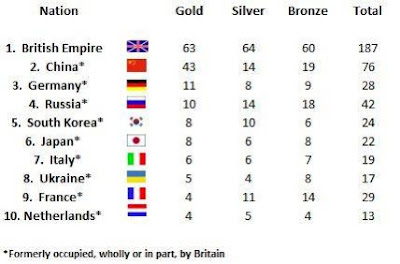
This one will run and run. For example, it strikes me that (excluding some Bavarians and the French and Italians) very few of the winners come from places where Roman Catholicism is predominant.
by Richard Gowan | Aug 21, 2008 | Conflict and security, Europe and Central Asia, North America
Der Spiegel has a fairly astonishing interview with Gerhard Schröder, a man who likes Russia:
SPIEGEL: Do you believe that the American military advisors stationed in Tbilisi encouraged Georgia to launch its attack?
Schröder: I wouldn’t go that far. But everyone knows that these US military advisors in Georgia exist — a deployment that I’ve never considered particularly intelligent. And it would have been strange if these experts had not had any information. Either they were extremely unprofessional or they were truly fooled, which is hard to imagine.
SPIEGEL: The US government claims that it warned Georgian President Mikhail Saakashvili against taking military action. But wasn’t the whole thing only too convenient for Russian Prime Minister Vladimir Putin?
Schröder: These are speculations in which I prefer not to participate. I assume that no one in the Moscow leadership has an interest in military conflicts. There are enough internal problems in Russia that need to be solved. For instance, corruption and abuse of authority must be addressed. Russia has plenty of deficits, an issue I’ve addressed many a time. President Medvedev and Prime Minister Putin are addressing these problems — together, by the way, in friendship and mutual respect, not in competition with one another, as journalistic fortune-tellers imply.
It’s like Brezhnev on codine. Still, Gerhard does manage one pithy moment:
SPIEGEL: The Republican presidential candidate, John McCain, followed up by saying: “Today we’re all Georgians.”
Schröder: I am not.
I’d sort of guessed.
by Richard Gowan | Aug 21, 2008 | Conflict and security, Europe and Central Asia
A story, and telling statistic, from Afghanistan:
According to a report in the Rheinische Post on Thursday, a German patrol was attacked late on Tuesday night not far from the base in Faisabad. The soldiers on the patrol, none of whom were injured, returned fire and killed one person. The event is noteworthy because it marks the first time in the six-year operation that the German army has killed someone there.
The person they killed, though, may not have been from the Taliban at all. According to a Wednesday report from a German news agency, the victim may have been an unarmed shepherd. The agency cites the police chief from the province of Badachshan, Agha Noor Keentoz, as saying that the man merely wanted to signal the patrol away from his herd of sheep. The German army is investigating the incident together with state prosecutors.
by Alex Evans | Aug 21, 2008 | Conflict and security, UK
Today’s Guardian leads with a restricted MI5 report they’ve seen on radicalisation. The standout finding:
Far from being religious zealots, a large number of those involved in terrorism do not practise their faith regularly. Many lack religious literacy and could actually be regarded as religious novices.
Very few have been brought up in strongly religious households, and there is a higher than average proportion of converts. Some are involved in drug-taking, drinking alcohol and visiting prostitutes.
MI5 says there is evidence that a well-established religious identity actually protects against violent radicalisation.
A useful nugget next time some wide-eyed weirdo tells you Islam is a death cult…
Update: oh. Just seen Charlie’s post below. Ahem.
