by David Steven | Aug 18, 2008 | Off topic
Perhaps you thought the Chinese were leading the Olympics medal table – maybe using erroneous information supplied by the official Olympics website, and copied slavishly by major media outlets such as the BBC:

However within the US it’s a different story, with Team America storming towards another Olympics victory:

How come the difference? The official table ranks countries by gold medals won (silver and bronzes are used for ties). The US version, in contrast, ranks by total medals – ensuring the greatest nation on God’s earth takes its proper position ahead of the rest of us.
[Question: Would it be churlish of me to point out that this is an innovation? That back in 2004, when the US won most golds, it used the same table as the rest of the world? Answer: Yes. Most definitely.]
by Charlie Edwards | Aug 18, 2008 | UK
A War On Terror board game has been seized by police who claim the balaclava in the set could be used in a criminal act.
The board game was confiscated from climate protesters during a series of raids near Kingsnorth power station, in Kent, last week. The game’s creators, Andrew Sheerin and Andy Tompkins, web designers from Cambridge, have expressed total shock at the inclusion of their toy among “criminal” items.
War on Terror, similar to games like Risk, revolves around creating empires that compete and wage war. But there is a twist – players can poke fun at the rhetoric of world leaders like George Bush and Tony Blair. Each player starts as an empire filled with good intentions and a determination to liberate the world from terrorists and from each other. Then the reality of world politics kicks and terrorist states emerge. Andrew said: “The terrorists can win and quite often do and it’s global anarchy. It sums up the randomness of geo-politics pretty well.”
Kent police said they had confiscated the game because the balaclava “could be used to conceal someone’s identity or could be used in the course of a criminal act”. Andrew fumed: “It’s absurd. A beard can conceal someone’s identity. Are the police going to start banning beards?”
All of which reminds me of this sketch by Monty Python.
Hat tip Schneier
by Jules Evans | Aug 18, 2008 | Europe and Central Asia
A good source for comment on foreign policy in the former Soviet Union is the website of the Eurasia Heritage Foundation, in my opinion Russia’s best think-tank, and certainly the one with the best English language website.
I saw this rather ominous comment there by Alexander Rahr, Russia expert at the German council on foreign policy and one of the few western Kremlinologists who’s actually a fan of the Putin regime:
“Yesterday I could say that in Europe there were differences in relation to Russia’s actions in South Ossetia. Some countries blamed Georgia for the conflict, others blamed Russia. For example, the French and German settlement plan was strongly supported. They pinned serious hopes on it.
But at present there is a different tendency. The USA has changed the Europeans’ opinion, and the EU and NATO may revise their relations with Russia seriously. Russia may be even excluded from G-8, the Russia-NATO Council may be disbanded, etc.
The Europeans have no political will and desire to be involved in the conflict in the Caucasus. The European politicians will not go beyond the talking stage. That means that the EU is most likely to let NATO play the key role in the settlement of the armed conflict, which would be a serious mistake.
Russia is short of good diplomatic tools to bring its position to Europe. Many Russian diplomats were educated in the Soviet system. They have revised their approaches, and changed a lot. But even now the West would understand only few of them. Europe will not accept the position “if somebody does not understand us, it is not our problems”.
There are quite a few Russians in Europe who have the European mentality. But there are no tools to make Russia’s position clear for the European policy-makers through those Russians.
And, just to get a taste of the nastiness of some Russian foreign policy comment, here is Alexey Arbatov, director of the International Security Centre in Moscow, mouthing off about the ‘public whipping’ of Georgia.
“Theoretically everything is possible, but in practice a world war is unlikely. Some things have changed compared with the First and Second World Wars.
“First, the great powers have developed many common long-term interests. Second, there are nuclear weapons that make victory in war impossible therefore making world wars meaningless. So, such a war is only possible if events escalate out of control. When, for example, a state takes a small step hoping to stop at that but other states retaliate by taking their own steps, the situation can then get out of control.
“Today we are on the brink, not of a new world war, but of a serious complication in relations between Russia and the West. Russia has, at long last, indicated where the “red line” lies: Moscow will not tolerate foreign military-political alliances in the post-Soviet space. Yes, we have surrendered the Baltics (but that was a special case), but Russia will not tolerate anything like that further.
“In general, the public whipping of Georgia is not only connected with South Ossetia, although Georgia provided more than a valid occasion for Russia to launch this action with a clear conscience. There is a background to the issue, namely, Georgia’s bid to join NATO and America’s wish to admit it to NATO. The process has gathered momentum and has provided the background to the conflict.
by Charlie Edwards | Aug 18, 2008 | Conflict and security, Influence and networks, UK
What better way to spend 25 minutes of this grey and overcast Monday morning digesting Richard’s and Daniel’s posts on military matters through the medium of political satire. Episode 5 of The Hollowmen sees the Central Policy Unit dealing with a recruitment crisis in the Australian Defence Force, a familiar issue for both the UK and US military.
But how do you tap into generation Y when they don’t find guns, bombs, and helicopters appealing and certainly don’t want to end up in Helmand or Basra?
Simple:spend lots of money on adverts that show no khaki, no explosions but shows a montage of young people pulling some shapes to a disco beat. The results delight the military but not everyone is happy. Watch Military Matters.
by Richard Gowan | Aug 15, 2008 | Conflict and security, Europe and Central Asia, Global system, North America, UK
Earlier this week, I wondered if we might soon see European personnel under Russian command in Georgia to help keep (well, keep an eye on) the peace. But Europeans are flexible about this sort of thing. In this hour of crisis, it’s good see that the Norwegian military was able to deploy thirty soldiers to Edinburgh zoo for the knighting of a penguin. This bird is Colonel-in-Chief of the Norwegian army. Frankly, if I were Nils the Penguin, I’d be looking to get a discharge: given the difficulties most European armies have sending actual troops overseas, I’d be worried that I might get my waddling orders for Gori at a moment’s notice.
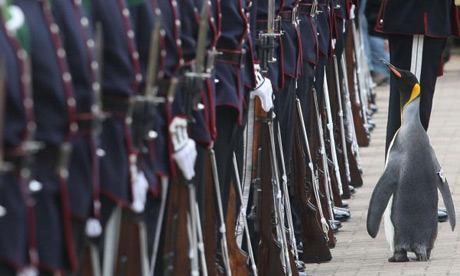
Comparing this – OK, fun – scene with the Russians in Georgia, and noting the latter’s strange decision to go into battle without even a War Puffin as back-up, I was drawn back to the recurrent theme of what Europeans think their troops are for. I’ve only dabbled with the subject, but recalled Daniel’s post in May about the disappearance of martial virtues in Europe. He took Britain as his case-study:
General Richard Dannat, the head of the British army, once remarked that the British Armed Forces are less understood and less honoured for their commitment and sacrifice by ordinary Britons than in comparable societies, like the U.S., and less than in earlier periods.
But this is not unique to Britain. And it is part of two broader inter-related trends: the disappearance of sacrifice as an element of Europe’s development and the divorce of the institution most known for sacrifice – the military – from European society.
And, in the meantime, we increasingly turn to military culture for entertainment, and then are shocked and befuddled when the troops have to go off to war – or other, less postmodern, powers like Russia opt to fight. I’d say more on the subject, but as I’m sat in a cafe in Brooklyn redrafting a pamphlet, I’m slightly conscious that my pondering martial virtues may ring a little a hollow…
