by Daniel Korski | Jul 29, 2008 | Conflict and security, Cooperation and coherence, North America, UK
National security reform is, I guess, one of the leitmotifs of this blog and both Charlie and I have written about this in its U.S and British forms.
Now, the U.S Project on National Security Reform (full disclosure: I advise the project pro bono) is about to publish its first report, Ensuring Security in an Unpredictable World: The Urgent Need For National Security Reform.
Based on research and analysis by more than 300 national security experts from think tanks, universities, federal agencies, law firms and corporations – it identifies the following major problems in in the national security system:
- Frequent feuding and jurisdictional disputes between cabinet secretaries and other agency heads that force the president to spend too much time settling internal fights, waste time and money on duplicative and inefficient actions, and slow down government responses to crises.
- Too much focus by the president and his top advisers on day-to-day crisis management rather than long-term planning, allowing problems to escape presidential attention until they worsen and reach the crisis level.
- An increasing number of political appointees who serve only briefly in top national security posts.
- A budget oversight process in Congress focused on individual agencies, crippling efforts to move quickly to fund emergency operations by multiple agencies.
- A Congress increasingly polarized along political party lines on vital national security issues.
PNSR member Thomas R. Pickering – who served as under secretary of state, ambassador to the United Nations and in other top posts in the State Department – has said:
Our national security system is broken and needs fixing. Agencies need to cooperate rather than compete with each other as they work to protect the United States from a broad range of new dangers never imagined when the National Security Act of 1947 was signed into law. This isn’t a Democratic or a Republican issue, but a challenge facing our country that must be met by America’s leaders on a bipartisan basis.
PNSR is scheduled to issue a final report in October recommending actions by Congress and the next president. The project is also expected to prepare draft presidential directives and a new National Security Act to replace many of the provisions of the one enacted 61 years ago. Now out of the presidential race, Senator Hillary Clinton is said to have taken a keen interest in sheparding legislation through Congress whilst both the Obama and McCain teams have had de facto representatives on the Project.
In other words: read the report available on here and watch this space…
by Charlie Edwards | Jul 29, 2008 | Climate and resource scarcity, Economics and development, Global system
This is shocking. Mud is fast becoming a staple part of Haiti’s poor in one of Port-au-Prince’s worst slums. Clay-based food is now a major income earner as mud cakes are the only inflation-proof food available to Haiti’s poor.
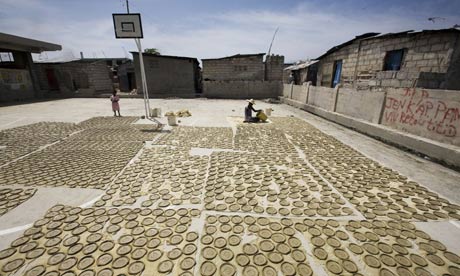
From the Guardian:
As desperation rises so does production of mud cakes, an unofficial misery index. Now even bakers are struggling. Trucked in from a clay-rich area outside the capital, Port-au-Prince, the mud is costlier but cakes still sell for 1.3p each, about the only item immune from inflation. “We need to raise our prices but it’s their last resort and people won’t tolerate it,” lamented Baptiste, the Cité Soleil baker.
Vendors of other foods who have increased prices have been left with unsold stock. In the Policard slum, a jumble of broken concrete clinging to a mountainside, the Ducasse family tripled the price of its fritters because of surging flour prices. “Our sales have fallen by half,” said Jean Ducasse, 49, poking at his tray of shrivelled wares.
by Richard Gowan | Jul 28, 2008 | Africa, Conflict and security, Cooperation and coherence, Influence and networks
After Jean-Marie Guéhenno’s comments last week on the perils of Darfur, here’s more plain speaking from a senior peacekeeper – in this case the Darfur mission’s commander, responding to a report criticizing his force…
General Martin Luther Agwai greeted the report’s recognition that the force was short of critical resources, saying that people had had unrealistic expectations. “If really you have an organisation that lacks critical resources and you expect that force to do magic then I think you are not being fair to the force,” he told the BBC.
He said many people had overlooked logistical constraints including delays at Sudan’s single sea port, and the large distance from the port to the area of operation in Darfur across land routes that are unusable during the rainy season. “People thought that things would work faster and better but the reality from the ground does not translate that way.”
But he also rejected concerns that the mission was doomed to fail, saying that it had the backing of the UN and the AU. “I’m not sure the United Nations and the African Union would want to fail because if they do, the whole world would fail. So based on that, I am optimistic.”
I find that optimism genuinely inspiring – analysts like me punch out our prophesies of doom while veteran peacekeepers get on with the actual job. But I fear that the whole world may be keen to avoid a perception of failure in Darfur, while having no idea of how to achieve (or even define) “success”. It’s Agwai’s task to provide as much security as he can with the resources he has. But for how long?
by Richard Gowan | Jul 28, 2008 | Climate and resource scarcity, Conflict and security, Global system
We overlooked last month’s Annual Disaster Statistical Review, but the numbers speak for themselves:
In 2007, 414 natural disasters were reported. They killed 16847 persons, affected more than 211 million others and caused over 74.9 US$ billion in economic damages.
Last year’s number of reported disasters confirmed the global upward trend in natural disaster occurrence. This upward trend is mainly driven by the increase in the number of reported hydro-meteorological disasters. Hydrological (essentially floods) and meteorological (storms) disasters are the major contributors to this pattern. In recent decades, the number of reported hydrological disasters has increased by 7.4% per year on average. Furthermore, we have witnessed a strengthening of the upward trend in recent years, with an average annual growth rate of 8.4% in the 2000 to 2007 period.
by Alex Evans | Jul 28, 2008 | Africa, Economics and development
Flying politicians out to developing countries to see poverty at first hand – and what aid programmes are doing to tackle it – is pretty standard fare for development NGOs. But it’s slightly more unusual for politicians to take the chance to perform surgical procedures on people’s lungs.
That, however, is just what former US Senator Bill Frist (and yes, he is also a surgeon, you’ll be relieved to hear) did on a trip to Mozambique organised by the One campaign this month. Probably more use than the average political visit to a developing country – though this line caused my eyebrows to raise slightly:
I operated with Dr. Morais having been given full surgical privileges granted for the length of our stay. He spoke little English, and I speak no Portuguese – but luckily, cutting and sewing don’t require any talking!
Er…