by Daniel Korski | Jul 30, 2008 | Conflict and security, Europe and Central Asia
Yesterday, my colleague and former senior MoD official Nick Witney pushed out a report on the future of European security and defense cooperation. Few people have as good a standing to think about European defence issues as Nick. He set up and served as the Chief Executive of the European Defence Agency, the organization established to make European armies spend more money in smarter ways on defence.
What he has to say is truly depressing: “inertia and resistance in the defence machinery”, he says, are thwarting the EU’s declared aim to make a real contribution to global security.
There is a chronic capabilities gap in Europe, as defence budgets are squandered on Cold War-style militaries. Europe keeps almost 2 million men and women in uniform (half a million more than the US), yet 70% of land forces are unable to operate outside national territory.
The total number of troops deployed today in ESDP operations, around 6,000, constitutes a paltry 0.3% of European military manpower. The failure to reform European militaries means that much of the annual 200 billion euro that EU governments spend on defence is, according to Nick, “simply wasted”.
Javier Solana has often been reduced to phoning defence ministers in person to secure a single transport plane or field surgeon. In Aceh, the operation was initially financed on the personal credit cards of mission personnel along with a loan from the entertainment allowance of the British ambassador in Jakarta.
What to do? Nick argues that Europeans will punch their weight – and be worthwhile partners for the US – only if they pool their resources and cooperate more closely. Reviewing the widely differing performances of the Member States (on defence spending, investment per soldier, participation record in operations), he urges the formation of “pioneer groups” of the most willing and able.
The idea, he argues, could be operationalised within the European Defence Agency through the creation of a number of overlapping pioneer groups, which each specialize in areas such as research and technology, armaments cooperation, defence industry cooperation, and the pooling of civilian and military capabilities.
The countries most active in various pioneer groups would constitute a European “core group” on defence – similarly to the “permanent structured cooperation” mechanism, envisaged by the Lisbon Treaty. Countries that do not meet basic criteria (like a minimum 1% of GDP spending on defence, and a 1% minimum level of personnel deployments ) should either commit to catch up, or leave the EDA. That means Austria, Bulgaria, Cyprus, Greece, Ireland, Luxembourg and Malta either need to raise their game, or get off the pitch.
This is not a call for a Euro Army; it is an honest appraisal of what ESDP is really made of, coupled with practical recommendations. With Nicolas Sarkozy having declared ‘l’Europe de la Defense’ a priority for France’s EU Presidency, his namesake’s report should be required reading in Paris, London and Berlin.
by Alex Evans | Jul 29, 2008 | Climate and resource scarcity, Cooperation and coherence, Economics and development, Global system
No-one quite wants to pronounce the patient dead just yet (US Trade Representative Susan Schwab: “This is not the time to talk about collapse … the US commitments remain on the table”; unnamed EU source: “It’s clearly not a success. But no one will want to say that it’s the end of the round”) – but it’s hard to see much sign of life either, especially after all of Pascal Lamy’s talk of this being the final, final, final deadline.
It’s ironic that at a point when all the talk is of how high food prices are, the issue on which the talks foundered was a mechanism designed to protect developing countries from low food prices. ICTSD explains:
The ’special safeguard mechanism’ would allow developing countries to raise tariffs beyond bound levels, in principle to stall inflows of cheap imports that could displace farmers. The issue neatly splits the interests of import-sensitive developing countries and competitive farm exporters, including those in the developing world: the former want to have recourse to protection, the latter want predictable access to overseas markets.
One of the main sticking points has been whether, and by how much, countries should be allowed under the SSM to impose safeguard duties in excess of current (i.e., pre-Doha) tariff ceilings. The G-33 bloc of developing countries, which includes China, India, and Indonesia, insists that this may sometimes be necessary for safeguard duties to have the desired effect, i.e., protecting farmers.
Or there’s the pithier version from another unnamed official, this time in the IHT:
It risks becoming a totemic issue: subsistence farming versus commodity exports.
That is, in some ways, the long and the short of the issue that led to the talks’ collapse, though needless to say there were many other sticking points too – and it’s another illustration of how debates over agricultural trade are increasingly split into divergent schools of thought. For fans of liberalisation – like the US – the logic is straightforward. With food prices as high as they are, there’s never been a better time to get rid of import tariffs – so why the hell should China and India want to be able to raise them even higher than they were before Doha?
China’s approach, on the other hand, is rooted in concerns about resilience and security of supply in a period of volatility and turbulence: hence its desire to maximise access to imports while at the same time protecting its internal agricultural sector, in which smaller farmers predominate. (While smallholders are inevitably at risk from dumping, they can also be extremely productive in the right circumstances: IFAD cites the example of Vietnam, which has gone from being a food-deficit country to being the world’s second largest exporter of rice – largely thanks to development of the country’s smallholder sector.)
It looks like there will be no further talks until towards the middle of next year, after elections in the US and India – even then, things are likely to be tougher than now given rising protectionist sentiment around the world. Also worth noting that the collapse of the talks – and in particular the acrimony between the US and the two key emerging economies – doesn’t exactly augur well for progress in climate talks.
If you want the full play-by-play, Alan Beattie’s post-mortem is where to go, and ICTSD will have the full details up on their site tomorrow.
by David Steven | Jul 29, 2008 | UK
Take a two-party system. Drop it into a multi-connected, media frenzied world. And what you get is a system with two steady states and dramatic swings between the two.
When you’re in, you’re in big time. Everything goes your way. But once you’re on the slide, it’s a one way trip to the wilderness. This is the world of disruptive politics – where it can be better to lose well, than even to try to win.
Disruptive politics has one imperative: to change the terrain on which political battles are fought. The disruption results from the opponent’s inability to react. He fights the old battle and is utterly hapless as a result. You know what he is thinking, can predict how he will react, and anticipate his every move with ease.
Margaret Thatcher and Tony Blair had instinctive mastery of disruptive politics. Neither was an intellectual colossus nor did they emerge from a vacuum. But, somehow, they had the skill to weave the threads of what was possible into a cloth that had a magical power to mystify their opponents.
The game was up for the Tories when Blair announced he was ‘tough on crime, tough on the causes of crime.’ Yet many Conservatives still believed they could win the 1997 election. They simply didn’t believe that Blair was who he said he was or believed what he said he did. They were still in denial four years later, fighting ‘Phoney Tony’ – their own chimera – rather than the real Prime Minister. Thatcher had previously bewitched Old Labour just as successfully.
In the US of the 80s and 90s, Reagan and (Bill) Clinton sowed similar confusion. For two elections, Democrats fought a George Bush of their own invention. Next Hillary battled an Obama who didn’t exist. Now McCain is doing the same thing. Obama is a flip flopper. No, he’s a lightweight. Wait, did I tell you the one about him ignoring the troops?
It took Margaret Thatcher’s fall to snap the Labour vanguard out of its trance. The second Gulf War has had a similar effect on the Tories. It’s like a return to sobriety – time to rebuild in the cold light of day. The Democrats, meanwhile, were saved by a Deus ex machina. The candidate from nowhere who will, I believe, win convincingly in November and should go from there to a resounding victory in 2012.
So where does this leave the Labour Party? Has it lost both this election and the next one? Well, that depends on what it tries to do now.
Faced with a superior force, the most important thing is to control the manner in which you lose. (Think of how an effective insurgent melts away when a conventional army marches into town – all the better to regroup and seize back the momentum when the time is right).
Should Gordon Brown step down (and I have no opinion on whether he will or should), then the overriding focus of his successor should be to take the party into opposition in good shape.
That means:
- Calling a general election as quickly as possible (while you’re still in a honeymoon period).
- Aiming to win the campaign, even if there’s little chance you can win the vote (you want to go into election day on the up).
- Arriving on the opposition benches with momentum on your side and morale high.
What you shouldn’t do:
- Hold onto power to the bitter end (by which time the press are already speculating about your successor).
- Lose the campaign and the vote (doing worse than the pundits predicted).
- Arrive in opposition fit only to tear yourselves to pieces for the next five years.
It’s a tough course to take and one that will need selling to the party faithful. After all, the faithful would often prefer to die in a ditch than live to fight another day.
by Charlie Edwards | Jul 29, 2008 | Conflict and security, Global system, North America
The new PNSR report reminds me of a recent speech by Robert Gates on the U.S. Global Leadership Campaign. From his speech:
To do all these things, to truly harness the “full strength of America,” as I said in the National Defense Strategy, requires having civilian institutions of diplomacy and development that are adequately staffed and properly funded…we have made significant progress towards pulling ourselves out of the hole created not only by the steep cutbacks in the wake of the Cold War – but also by the lack of adequate resources for the State Department and the entire foreign affairs account going back decades.
…For the first time in a long time, I sense real bipartisan support in Congress for strengthening the civilian foreign affairs budget. Shortfalls nonetheless remain. Much of the total increase in the international affairs budget has been taken up by security costs and offset by the declining dollar, leaving little left over for core diplomatic operations. These programs are not well understood or appreciated by the wider American public, and do not have a ready-made political constituency that major weapons systems or public works projects enjoy. As a result, the slashing of the President’s international affairs budget request has too often become an annual Washington ritual – right up there with the blooming of the cherry blossoms and the Redskin’s opening game.
It has become clear that America’s civilian institutions of diplomacy and development have been chronically undermanned and underfunded for far too long – relative to what we spend on the military, and more important, relative to the responsibilities and challenges our nation has around the world.
… the budgets we are talking about are relatively small compared to the rest of government, a steep increase of these capabilities is well within reach – as long as there is the political will and wisdom to do it.
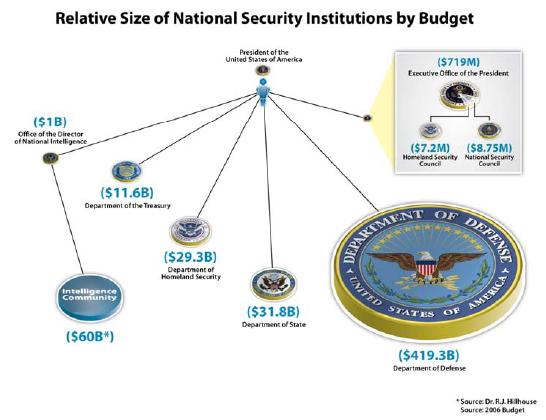
The PNSR report has a nice graphic on the relative size of national security institutions by budget:

(I did something similar with the UK national security budget last year).
by Alex Evans | Jul 29, 2008 | Climate and resource scarcity
[youtube:http://www.youtube.com/watch?v=zY__KBYJjMM]
Freed from the nice-guy constraints of being Josh on the West Wing, Bradley Whitford was clearly having a grand old time as a Machieavellian oil industry lobbyist in Burn Up on BBC2 last week; Neve Campbell and Rupert Penry-Jones (from Spooks) completed the ensemble cast for a production that cost the BBC $15 million to make. Watch it if you haven’t already – if you live in the UK, you’ve got until 10.29pm on Wednesday 30th July to stream or download both episodes via the BBC’s Iplayer (if you download, you then have 30 days to watch them).
It was a riot – above all because, notwithstanding that this was a political thriller, the scriptwriter (Simon Beaufoy of The Full Monty fame) had really done his homework on climate change and energy policy (a task in which he was helped by Joe Smith from Open University, who co-edited Do Good Lives Have to Cost the Earth? with Andrew Simms).
So we were treated to climate summits with delegates negotiating square bracketed text through the night as the US and OPEC countries raise flags to object to use of the word ‘mandatory’; China playing it both ways, cutting a deal with the EU for carbon sequestration before dropping them like a stone when the US offers free nuclear power instead (agonised British head of delegation: “the Chinese have stitched us up!”); and even – ta da! – the sight of climate negotiators agreeing a climate framework based on per capita convergence, with proper terminology and everything.
However (spoiler alert: stop reading now if you plan to watch it), all of this then falls apart when ‘moderates’ in the US delegation (“Withdraw that proposal, Tuvalu, or kiss your AIDS funding goodbye”) are replaced by even nastier military-industrial-spook types, who – it later transpires – have a Secret Plan, the gist of which is that the US is deliberately allowing climate change to happen on the basis that if it will damage the US, it will really screw China.
As prospects for a global deal recede, oil company CEO Rupert Penry-Jones (who has had a Damascene conversion to the path of climate righteousness after watching an Eskimo set herself on fire in protest at global warming, and then seeing methane hydrate plumes catching fire in holes in the Arctic pack ice as positive feedbacks start to kick in) decides to start playing real hardball: so he leaks secret geological data from Saudi Arabia to environmentalists (and thence the media), which shows that – ta da ! – Peak Oil is upon us. The film closes with snippets of media reporting of the massive economic crash that follows, and the prospect of something called the ‘third energy age’.
Only thing is, it’s not entirely clear why Penry-Jones has abandoned his earlier view that to tell the world that the oil peak is already passed would be a Very Bad Idea on the basis that it would (a) cause economic Armageddon, (b) kill thousands if not millions and (c) cause World War Three. I was sort of with Bradley Whitford’s evil lobbyist when he suggested that allowing the news to leak out ve-e-ery gradually might be a better approach. Leaking the news of Peak Oil being already behind us also looks to me like as much of a recipe for tar sands, liquids from coal and all US corn going to biofuels as it does a recipe for solar, wind and the ‘third energy age’.
But hey. Top marks to the Beeb for definitely the edgiest (and most politically accurate) climate drama we’ve seen so far. Eat your heart out, The Day After Tomorrow.