by Richard Gowan | Jun 20, 2008 | Climate and resource scarcity, Conflict and security, Global system, North America
At the start of the month, I tried to write a wry and whimsical post about signs of scarcity in Putnam County, a beautiful bit of hill country north of New York City. Well, sometimes you’re trying to do whimsy and you come over as a bit of a dick. Although it wasn’t possible to comment on the post (any blog that involves internet hate figure Daniel Korski has to take such measures) one Putnam resident ferreted out my e-mail address to point out that I’d got my facts and analysis wrong.
I won’t reprint the entire correspondence, but the central issue has been Putnam County’s 1970s Indian Point nuclear power station, which I mocked as “Olde Worlde” and a menace to the community. That’s not a unique point of view – heck, even folk legends Pete Seeger and Ani DiFranco claim that “Indian Point is leaking radioactive waste into the Hudson River, is one of the most vulnerable terrorist targets, and has 20 million people without a workable evacuation plan living in its shadows.” And for those who aren’t convinced that folk genius and knowledge of energy security are one and the same thing (I have visions of Steeleye Span commenting on pipeline issues) an organization called Riverkeeper bashes away at Indian Point and other polluters along the Hudson River.
All ostensibly convincing. But my correspondent says it’s all deeply misleading: “Putnamers in general do not subscribe to the PR-based notion of Indian Point as a problem. That notion flies higher the further away from the animal itself one gets.” He counters that Putnamers appreciate the employment Indian Point brings; fear that the alternative would be coal-fired power stations that would ruin the area’s excellent air quality; mistrust Riverkeeper and are generally weary of “negative snark” from ” the gentrification corps up from SoHo”. Now, I live in Brooklyn, but I plead guilty of snarking without fact-checking.
Of course, it’s possible that my correspondent doesn’t speak for a majority in Putnam County either – for once, I’m going to allow comments on this post to see if anyone else from that part of the world wants to contribute (but if you wish to weigh in on the merits of Steeleye Span as political commentators go here instead). Still, I’m convinced for now – as David has pointed out, energy and emissions issues are going to loom large in U.S. politics before and after the elections, so it’s good to look at the issues from the ground up. My correspondent and I ended up 100% agreeing that everyone should spend some time in Putnam County – go to Cold Spring from Grand Central via Metro North. It’s great.
by Alex Evans | Jun 20, 2008 | East Asia and Pacific
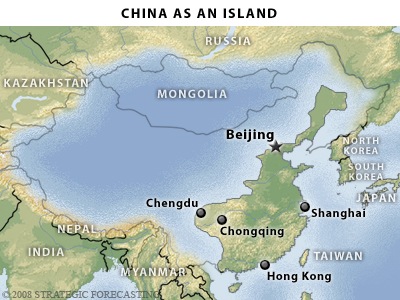
So says Kevin Kelly on what is now my favourite blog. Here’s why:
China shares borders with more countries (14 in total) than any other country on earth. Very few of those borders have ever been very permeable to migration of culture, commerce and ideas because of mountains, deserts, swamps, and high altitudes. In many ways China has acted as an island for millennia. The very large zone of an impermeable buffer, and mountainous and unfarmable land is shown in this image as water.
What’s left is the island of China. This is the traditional center of China, of fertile river valley farming, and home to the Han people. It is also the zone of manufacturing today. It is where all of its giant, throbbing cities lie. The island alone is huge, still among the largest countries in the world.
Prosperity in China is found only on the island. Off the island, in the waters deep, China remains remarkably undeveloped. In fact the level of development in the “Chinese waters” is about equal to the low levels of the neighboring countries. I was surprised to find in my own travels that many towns in the Chinese waterland were as remote, poor, and disadvantaged as any places I had seen in Nepal, Burma, Bangladesh, Pakistan, Afghanistan — all neighbors of China. Not coincidentally, this waterland is also inhabited by non-Han peoples, what the Chinese call their minorities. It is not just Tibet where the nan-Han are outnumbered. In most of the counties covered by this buffer zone (shown as water), minorities dominate. There are lots of them, speaking their own language, often their own dress. What is most remarkable is how remote the rich island seems from the outer waterlands.
The China everyone talks about is the island. China’s worry is the outer zone will leave. Will they go the way of the Soviet Union and break off one by one? Will there be two futures? Much of the control-freak nature of the central political party has been trying — at almost all costs — to keep the whole waterland under control of the island — to keep the country intact. And when you look at this map, it is clear that a break up, or at least a break down, is a very real possibility. In fact the more you look at it, the more amazing it is that China has not devolved before now.
by Alex Evans | Jun 20, 2008 | Climate and resource scarcity, Global system, North America
If there’s a silver lining to the disastrous flooding in the US mid-west, then this might be it. As prices for corn go through the roof, the impacts of diverting so much of it to ethanol production – expectations before the flooding were of fully a third of this year’s crop – are leading to an increasingly determined push-back from the US food industry.
Of course, the effects of corn-based ethanol on food prices aren’t exactly a newsflash: Mexico City saw riots on this very subject back in February 2007, well before food prices had reached the top of the global agenda. But the extreme weather event that the US midwest is now experiencing shifts the intensity of debates up by at least two gears.
At present, the FT reports, US biofuel rules require 9 billion gallons of biofuels to be blended into transport fuels this year – mostly with corn-based ethanol. But the US Environmental Protection Agency can – if it chooses – waive the requirement. Texas has asked it to do just that – and food producers, as they watch their costs rocket – are asking it to do the same nationally. As one food company chief puts it, “it is not fair to expect us to compete with a government-subsidised market”. It’s a fair point.
As readers will already be aware, the importance of corn to the US food economy goes far, far beyond cornflakes and tins of Green Giant sweetcorn. If you haven’t already done so, read Tim Flannery’s excellent NYRB article from last summer entitled “We’re living on corn!” – he’s not kidding:
[Michael] Pollan gives us the example of the chicken nugget, which he says “piles corn upon corn: what chicken it contains consists of corn” (because the chickens are corn-fed), as does “the modified corn starch that glues the thing together, the corn flour in the batter that coats it, and the corn oil in which it gets fried. Much less obviously, the leavenings and lecithin, the mono-, di-, and triglycerides, the attractive golden coloring, and even the citric acid that keeps the nugget ‘fresh’ can all be derived from corn.
So dominant has this giant grass become that of the 45,000-odd items in American supermarkets, more than one quarter contain corn. Disposable diapers, trash bags, toothpaste, charcoal briquettes, matches, batteries, and even the shine on the covers of magazines all contain corn. In America, all meat is also ultimately corn: chickens, turkeys, pigs, and even cows (which would be far healthier and happier eating grass) are forced into eating corn, as are, increasingly, carnivores such as salmon.
If you doubt the ubiquity of corn you can take a chemical test. It turns out that corn has a peculiar carbon structure which can be traced in everything that consumes it. Compare a hair sample from an American and a tortilla-eating Mexican and you’ll discover that the American contains a far larger proportion of corn-type carbon. “We North Americans look like corn chips with legs,” says one of the researchers who conducts such tests.
And of course, turning food into fuel is only half the story: for America’s love affair with corn is also the tale of turning fuel into food – on a truly epic scale. In the US, according to academics David Pimentel and Mario Giampietro, even back in 1994 the equivalent of 400 gallons of oil was expended each year to feed each US citizen. Meanwhile, another study – this time of Canadian farms – gives an idea of how this energy use breaks down:
– 31%: manufacture of inorganic fertiliser
– 19%: operating field machinery
– 16%: transportation
– 13%: irrigation
– 8%: raising livestock (not including feed)
– 5%: crop drying
– 5%: pesticide production
Now, you may be wondering: if it takes this much energy to produce corn, how can it make sense then to use that corn as an energy source? Wouldn’t that seem, not to put too fine a point on it, wantonly defiant of the laws of thermodynamics? Alas, it would. Indeed, studies show that the energy-returned-on-energy-invested (EROEI) of corn is actually negative: corn ethanol requires 29 per cent more energy to grow than what you can get out of it.
Rewind! One more time: corn ethanol requires 29 per cent more energy to grow than what you can get out of it. You may have seen some pretty mad subsidies in your time, but I’ll wager that none tops this; watching America tie itself in knots thus, one can’t help but feel an awestruck respect for the thunderous public affairs capacity of the US farm lobby.
Still, as we watch the US farm lobby and the US food lobby start to join battle, one might reflect that neither is clearly doing many favours for the public interest. Corn-based ethanol may be an obviously stupid policy. But it’s hard to see a diet as rich in red meat, saturated fat and processed food (all derived from corn) as is America’s, as being much more sensible – especially given that the globalisation of that diet is the number one driver of rising global food prices.
by David Steven | Jun 19, 2008 | Middle East and North Africa, North America
Day by day, it seems more likely that senior members of the Bush administration will be prosecuted for war crimes.
There’s a new report out on medical evidence of US torture. Antonio Taguba, the Major-General who investigated Abu Ghraib and was then forced to retire, wrote the preface:
This report tells the largely untold human story of what happened to detainees in our custody when the Commander-in-Chief and those under him authorized a systematic regime of torture. This story is not only written in words: It is scrawled for the rest of these individuals’ lives on their bodies and minds. Our national honor is stained by the indignity and inhumane treatment these men received from their captors.
Taguba continues:
After years of disclosures by government investigations, media accounts, and reports from human rights organizations, there is no longer any doubt as to whether the current administration has committed war crimes. The only question that remains to be answered is whether those who ordered the use of torture will be held to account.
These are some of the practices documented in the report:
- Suspensions and other stress positions;
- Routine isolation;
- Sleep deprivation combined with sensory bombardment and temperature extremes;
- Sexual humiliation and forced nakedness;
- Sodomy;
- Beatings;
- Denial of medical care;
- Electric shock;
- Involuntary medication; and
- Threats to their lives and families.
Meanwhile, evidence is slowly mounting to show that torture was authorised at the highest levels of the Bush administration. Mark Benjamin has a useful time line. Under questioning, senior officials are sounding increasingly desperate:
William “Jim” Haynes II, the man who blessed the use of dogs, hoods and nudity to pry information out of recalcitrant detainees, proved to be a model of evasion himself as he resisted all attempts at inquiry by the Armed Services Committee.
Did he ask a subordinate to get information about harsh questioning techniques?
“My memory is not perfect.”
Did he see a memo about the effects of these techniques?
“I don’t specifically remember when I saw this.”
Did he remember doing something with the information he got?
“I don’t remember doing something with this information.”
When did he discuss these methods with other Bush administration officials?
“I don’t know precisely when, and I cannot discuss it further without getting into classified information.”
People are going to go to jail for this – and they’ll be much more senior than the small fry currently doing time. How high will the investigation go? Higher than most commentators probably think…
by David Steven | Jun 19, 2008 | Europe and Central Asia, Middle East and North Africa, North America
Remember Curveball? The intelligence ‘source’ who supplied ‘virtually all of the [US] Intelligence Community’s information on Iraq’s alleged mobile biological programs.’
As a refresh, here’s what the US Presidential Commission on intelligence screw-ups made of the episode:
One of the most painful errors… concerned Iraq’s biological weapons. Virtually all of the weapons facilities was supplied by a source, codenamed “Curveball,” who was a fabricator. We discuss at length how Curveball came to play so prominent a role in the Intelligence Community’s biological weapons assessments. It is, at bottom, a story of Defense Department collectors who abdicated their responsibility to vet a critical source; of Central Intelligence Agency (CIA) analysts who placed undue emphasis on the source’s reporting because the tales he told were consistent with what they already believed; and, ultimately, of Intelligence Community leaders who failed to tell policymakers about Curveball’s flaws in the weeks before war.
Well Curveball – real name Rafid Ahmed Alwan – has just given his first media interview and it turns out that he’s even more of a sad sap than we realised. He’s remained in Germany, from where he is denying everything:
I never said Iraq had weapons of mass destruction, never in my whole life. I challenge anyone in the world to get a piece of paper from me, anything with my signature, that proves I said there were weapons of mass destruction in Iraq.
But he seems to have told some fairly obvious lies in his fifty or so meetings with German intelligence (meetings that were used in 100 or more US intelligence reports):
He claimed, for example, that the son of his former boss, Basil Latif, secretly headed a vast weapons of mass destruction procurement and smuggling scheme from England. British investigators found, however, that Latif’s son was a 16-year-old exchange student, not a criminal mastermind.
When a Western intelligence team interviewed Latif outside Iraq in early 2002, a year before the war, he warned that Alwan had been fired for falsifying invoices at work. Latif also denied that anyone produced biological weapons at the plant where he worked with Alwan.
“They thought I was lying,” Latif, who now lives in Oman, said in an interview. “But I was telling the truth. It upset me very much
A serial fraud, who had been fired from numerous jobs, Alwan fled Iraq after a warrant was issued for his arrest for the theft of cameras from his employer. But German intelligence thought he was a good source because he “was understated…the opposite of a braggart, and that was impressive.”

Colleagues at Burger King (purveyor of the Whopper) where Alwan flipped burgers were less easily fooled:
In early 2002, a year before the war, he told co-workers at the Burger King that he spied for Iraqi intelligence and would report any fellow Iraqi worker who criticized Hussein’s regime.
They couldn’t decide if he was dangerous or crazy.
“During breaks, he told stories about what a big man he was in Baghdad,” said Hamza Hamad Rashid, who remembered an odd scene with the pudgy Alwan in his too-tight Burger King uniform praising Hussein in the home of der Whopper. “But he always lied. We never believed anything he said.”
Another Iraqi friend, Ghazwan Adnan, remembers laughing when he applied for a job at a local Princess Garden Chinese Restaurant and discovered Alwan washing dishes in the back while claiming to be “a big deal” in Iraq. “How could America believe such a person?”
My thoughts exactly.

