by Alex Evans | Jun 26, 2008 | Climate and resource scarcity, Influence and networks
WEF has just published a statement on climate change ahead of the G8 from what appears more or less all of the world’s CEOs (A is for ABB, Abercrombie & Kent, Agility, AIG, Airbus, AkzoNobel, Alcoa, AMD, ANA, Anglo American, Arup; B is for Bain & Co., Bayer, BG Group, Booz & Co., BP, British Airways, BC Hydro, BT… oh, you get the idea). They say this:
Addressing climate change will require clear and honest communication as to the scale of the challenge we all face. Lord Stern describes the problem for us succinctly:
“Current annual global emission flows are around 40-45 Gigatonnes of CO2 equivalent (GtC02-eq).
About 45% of current global emissions come from developing countries and this is set to grow.
A 50% reduction in global emissions by 2050 equates to an aggregate annual flow of around 22GtC02-eq.
As there will be around 9 billion people in 2050, this implies per capita emissions per year of about 2-2.5 tonnes CO2-eq.
Currently, US emissions are more than 20 tonnes of CO2-eq per person per year, Europe and Japan 10-15 tonnes, China 5 or more tonnes, India around 1.5 and most of Africa much less than 1 tonne CO2-eq per person per year.
The consequence is that rich countries will have to take the lead and demonstrate strong cuts.
Since around 8 billion people will be in currently developing countries, those countries will also have to be in the range of 2-2.5 tonnes CO2-eq by 2050, otherwise the world average for the total would be unachievable.
Refreshing to see some actual numbers rather than the usual guff about “developed countries taking the lead”, isn’t it?
by Alex Evans | Jun 26, 2008 | Global system, North America
The United States Advisory Commission on Public Diplomacy, which reports to President Bush, published a report yesterday on (you guessed it) public diplomacy – specifically, on the human resources dimension of the challenge.
As Matt Armstrong at MountainRunner reports, one of the report’s key concerns is that there isn’t enough dedicated resource available for US public diplomacy work. While public diplomacy officers want to prioritise communicating with people where they’re based, they can’t – because “90% of their job descriptions and work requirements are something else, like administration”. The report worries “there is no one overseas whose primary job responsibility is to interface with foreign audiences”.
Moreover, Armstrong continues, PD officers find their career tracks hampered in DC as well. People on the public diplomacy track face a glass ceiling; no public diplomacy officer has ever become the Under Secretary for Public Diplomacy and Public Affairs; public diplomats are under-represented in senior management compared to other career tracks like economics, political, consular and management.
It’s easy to see why the Advisory Commission would be worried if public diplomats “view themselves, and are viewed by others, more as managers and administrators than as expert communicators”; likewise, it’s hard to argue against the idea that everyone who works on public diplomacy should “have at least one work requirement entailing substantive engagement with the host country public”.
Where I diverge from the Commission, though, is over their acceptance that public diplomacy can be seen as a separate discipline from other parts of diplomacy – and above all the political component. Armstrong thinks that “the problem is perhaps that State went too far to integrate public diplomacy, pushing a square peg into a round hole”. But you can argue the converse, too: that in today’s world there will never be a neat line between work with politicians on one hand and work with the media and with diverse publics on the other; that all of these tasks take place within the same political discourse; and that in all of these contexts, the core task and skill-set is the same: influence.
Sure, it’s a problem if State doesn’t “recruit for public diplomacy, test for public diplomacy, train for public diplomacy”. But I’m not sure that any of those three things has to imply a separate cadre of people. The implication of the ‘civilian surge‘, of a 24 hours news cycle, of the globalisation of risk and the erosion of borders may be that public diplomacy is – simply – tomorrow’s diplomacy.
by Charlie Edwards | Jun 25, 2008 | Conflict and security, UK
This afternoon I’m giving a presentation to the Sandhurst Defence Forum. The subject of my talk: Strategic Myopia develops some of the themes from the report I wrote last year and focuses on a number of issues resulting from the publication of the UK’s first national security strategy.
There hasn’t been much news on the UK NSS for sometime (no one seems to have noticed, for example, the civil defence force initiative has been quietly dropped). That said, today’s papers are ablaze with news of Sir Jock Stirrup’s warning that sustaining operations in both Afghanistan and Iraq is becoming almost impossible. From his interview with the press gallery:
“We are not structured or resourced to do two of these things on this scale on an enduring basis but we have been doing it on an enduring basis for years,” Sir Jock said. “Until we get to the stage when one of them comes down to small scale, we will be stretched beyond the capabilities we have.”
3 things spring to mind:
- Where is the Defence Secretary Des Browne? Aside from the MoD’s official spokesmen, General Sir Richard Dannatt and the CDS seem to be the only ones who speak on behalf of the department. Is there any political leadership in the MoD?
- Have the MoD really developed any sustainable planning assumptions going forwards (see after the jump)?
- Is this all actually a ruse to get a better deal out of the forthcoming white paper on support for the military?
Stunts like Liam Fox’s announcement last week for military families to get preferential access to public services is nice PR but hideously impractical. But it plays well with the media (though I doubt it plays well with the military).
The point is that announcement like Sir Jocks increases the need for a new defence review. Given this is very unlikely before the general election in 2010, the MoD has got to come up with a sound strategy for the next couple of years. Keeping Minister’s quiet and letting General’s do the talking should not be part of it.
Bonus post: If like me, you have been wondering why the defence planning assumptions seem to increasingly irrelevant and out of step with current operations I’ve posted some information on the current DPAs after the jump (more…)
by David Steven | Jun 24, 2008 | North America
The good news from today’s World Public Opinion poll on torture? A majority of Americans oppose torture in all circumstances.
The bad news? 31% believe that terrorists should be tortured to save innocent lives. And worse, more than one in eight believe that “in general governments should be allowed to use torture to try to get information”, even “in cases that have nothing to do with terrorism.”
In the UK, 82% oppose torture in all cases, 11% would torture terrorists, while 4% would allow Gordon Brown to water board David Davis.
Full results:

Title courtesy of Mr Blonde.
by Charlie Edwards | Jun 24, 2008 | Africa, East Asia and Pacific, Middle East and North Africa, South Asia
Over on ArmscontrolWonk they have been analysing the arc of crisis map from the recent French White paper on national security and defence. They’ve done a great job at distinguishing what all the shapes (originally plotted on the map by hand) mean:
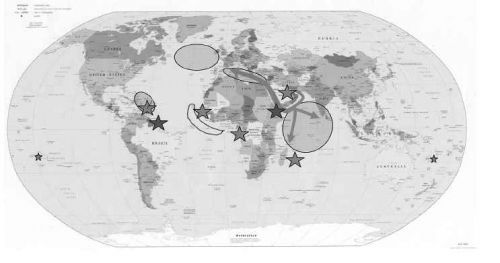
Circles: Main naval areas of patrol/operations.
Dark stars: Bases belonging to the “Forces de souveraineté” category, on French overseas territories.
White stars: Bases on the Atlantic coast of Africa.
Grey stars: Djibouti and Abu Dhabi/UAE bases, on which the French forces will be relying more and more, due to the shift of priorities from Africa to Asia, also reflected in the arrow pointing to the Indian Ocean.
(Hat tip Guy de Loimbard)
Readers of GD will note how similar the French arc of crisis is to the arc of stability – made famous by Tom Barnett:


