by Daniel Korski | May 14, 2008 | Conflict and security, Influence and networks
Last night I had dinner with a group of security experts and sat next to Chatham House’s Robin Niblett . We got to talking about the role of Ministers and how they seem to struggle with their role in overseeing today’s counter-insurgency missions i.e. operations like in Iraq. They shy away from detail, but are forced into minutiae by events. They go for headline-grabbing figures – like withdrawal numbers – that rarely materialise. They oversell missions – does anyone remember John Reid’s comment that British soldiers would not fire a shot in Helmand? You get the point.
However, is this any different from the past; and if so, why?
Even a cursory reading of Churchill’s memoirs or those of any of his wartime colleagues (like his defense chief, Lord Alanbrooke) leaves you with the impression that no detail was too small, no maneuver too inconsequential for the PM to take an interest – and, frequently, a direct role. As we know, this did not always have the intended beneficial effects, but the PM’s involvement was clear, all-pervasive – and ultimately crucial for Britain’s war-time effort.
But in the 1950s, 60s and 70s as Britain fought countless battles against Soviet-backed, liberation movements – the heyday of counter-insurgency – the role of Whitehall seemed to decrease. Decisions were delegated to theatre level, as in the Malay campaign. It was only when the Troubles began – and the fight was brought home – that the day-to-day involvement of Whitehall began to increase.
But besides Northern Ireland, the Cold War did not include – indeed require – day-to-day ministerial oversight. Plans were laid to roll back a Red Army advance and the PM had to write a letter to submarine commanders bearing instructions for nuclear retaliation. But there was no day-today role. The Falklands War was may have been an exception to this hands-off, strategy-focused Cold War role.
In the modern world, however, wars like the Iraq War are fast-paced, cost billions of pounds, risk the lives of hundreds of soldiers and can cost ministers their careers. This drives greater ministerial involvement in decision-making than before. But, on the other hand, the complexity – and sometimes brutality – of modern counter-insurgency means many ministers are reluctant to get too involved in decisions, lest they be blamed for the choices made by a soldier in Basra or a diplomat in Kandahar. (more…)
by David Steven | May 14, 2008 | North America
No comment needed:
For the first time, Bush revealed a personal way in which he has tried to acknowledge the sacrifice of soldiers and their families: He has given up golf.
“I don’t want some mom whose son may have recently died to see the commander in chief playing golf,” he said. “I feel I owe it to the families to be in solidarity as best as I can with them. And I think playing golf during a war just sends the wrong signal.”
Bush said he made that decision after the August 2003 bombing of the United Nations headquarters in Baghdad, which killed Sergio Vieira de Mello, the top U.N. official in Iraq and the organization’s high commissioner for human rights.
“I remember when de Mello, who was at the U.N., got killed in Baghdad as a result of these murderers taking this good man’s life,” he said. “I was playing golf — I think I was in central Texas — and they pulled me off the golf course and I said, ‘It’s just not worth it anymore to do.'”
by Alex Evans | May 14, 2008 | Climate and resource scarcity
Just back from ten gorgeous days on holiday in Cornwall – hence radio silence on the blogging front, and a much-needed break from frenetic activity on the food prices research front.
(As I found, Cornwall is actually about the best place you could go to get some fresh perspective on food. The Lost Gardens of Heligan have the most impressive kitchen gardens I’ve ever seen; the Eden Project fizzes with thoughts about how we’ll feed ourselves through this century; and Tim Smit – who led the construction of Eden and the restoration of Heligan – and Tony Kendle, director of the Eden Foundation, were both full of ideas about the future of food. Plus, just over the Devon border is Totnes, home of the transition towns movement – which John Robb admires as an exemplar of the idea of the resilient community.)
So with last month’s briefing paper on food prices out of the way, I’m starting to think in earnest about the content of the main pamphlet that I’ll be writing over the summer.
Although we’re not out of the woods yet on gearing up the humanitarian response to immediate term food price impacts, the issue is firmly on the agenda; by the time of the G8 at the start of July, most governments should have made their initial pledges of increased assistance. Meanwhile, the UN’s new task force on food prices met for the first time on Monday, and will pull together a framework for action over the next few months.
But what about the longer term? What are the big questions we need to think through between now and the Italian G8 in 2009, by which time we’ll need to have thought through a global plan for the longer term challenge of meeting 50 per cent higher demand by 2030 – and a population of nearly ten billion by 2050?
I’m tentatively organising my thoughts into three main clusters: questions about the future of agriculture; questions about the future of trade; and questions about the future of demand for food among wealthier consumers. (more…)
by Daniel Korski | May 13, 2008 | Middle East and North Africa
After a period of silence on the “Iran file”, the P5+1 will present Tehran with a new incentive package to convince the Iranians to suspend their enrichment program and enter negotiations. This is the second time the five permanent members offer a package. The first time was in 2006, which was rejected by Tehran.
Nobody thinks Tehran will accept the new offer as it crosses its red line – suspension of enrichment – and does not give Tehran what they want most i.e. U.S non-aggression guarantees (by a new U.S president).
On Monday, Iranian Ambassador Ali Asghar Soltanieh ruled out accepting intrusive nuclear inspections unless there was an end to “double standards” on global non-proliferation that it said benefited nuclear arms powers.
But, as a report by the NIA Council, asks: why is this offer being made now? Trita Parsi notes the “nuclear offer coincides with an escalation of rhetoric between Washington and Tehran over allegations of Iranian meddling in Iraq.”
General David Petreus, the new head of CENTCOM, is reportedly preparing a presentation of evidence showcasing Iran’s direct involvement in the violence in Iraq. He is on record as seeing Iran’s hand in Iraq. But he – and the Bush administration – may be looking to shape the autumn’s electioral discussion of Iran.
If so, they are unlikely to succeed. On Iran, there are three policy options: what can be described as 1) “the coercive option”; 2) a Denis Ross-style incremental diplomacy; or 3) a game-changing event like a major offer of a “grand bargain”, which includes security guarantees.
The EU would obviously favor the latter, but I think that all presidential candidates, including John McCain, would at some point be willing to go down this route whatever their current rhetoric. Either way, it makes the timing of the P5+1 offer peculiar.
by Charlie Edwards | May 13, 2008 | Climate and resource scarcity, Conflict and security
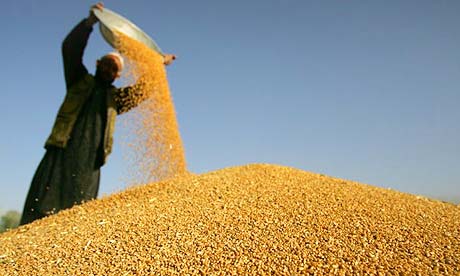
Is the global economic situation having an impact on poppy eradication in Afghanistan? Afghan farmers are capitalising on soaring food costs by growing wheat instead of poppy crops, with the fall in heroin prices further fuelling the switch. This comes at a time when the price of a tonne of wheat in Afghanistan has almost trebled this year, causing acute food shortages.
This may be the case in some regions, but Helmand may be off limits because of instability while some farmers may be put off by difficulties in getting their crops to market as roads are dangerous with bandits roaming the countryside.