by Alex Evans | Apr 22, 2008 | Off topic
From Gizmodo, a terrible tale of technology, misunderstanding and revenge. Our story begins in Turkey, where Emine and Ramazan are in the process of separating. After deciding to split, they continue to hurl barbs at each other by text message – including one from Ramazan in which he accuses his wife thus:
You change the topic every time you run out of arguments.
Problem was, the whole meaning of the sentence hinged on Emine’s cellphone’s capacity to understand a special Turkish alphabet character called a ‘closed i’ – and it couldn’t, because of faulty localisation of the hardware. As a result, the message that Emine actually received read like this:
You change the topic every time they are fucking you.
At this point,
Emine then showed the message to her father, who—enraged—called Ramazan, accusing him of treating his daughter as a prostitute. Ramazan went to the family’s home to apologize, only to be greeted by the father, Emine, two sisters and a lot of very sharp knives.
Injured and bleeding, with a knife on his chest, Ramazan tried to escape. Emine was still trying to finish him on the door, but he managed to take the knife out of his chest and attacked back, wounding her. Ramazan finally escaped, and was caught by the police, but Emine bled to dead as the family waited for an ambulance to cross Ankara’s hellish traffic to reach their home. Confused by all the events, he later killed himself in jail.
Blimey.
by Alex Evans | Apr 22, 2008 | Conflict and security, Middle East and North Africa, South Asia
Barney Rubin has an excellent post updating on latest developments in Pakistan’s federally administered tribal areas. Start, he says, from a clear recognition of one thing at least: the US has no plan. Here’s a graph from the US Government’s General Accountability Office which proves the point:
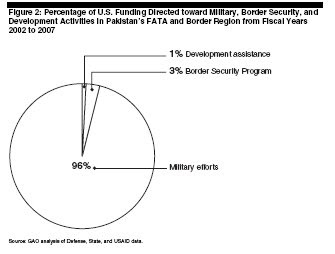
Note especially the amount being allocated to political reform, he says: 0%. Meanwhile, Khalid Aziz – the former chief secretary of NWFP – has been doing some serious strategising about what needs to happen next (in the wake of Pakistan’s elections – which as the BBC put it “saw an overwhelming vote for parties that advocate secularism, or the separation of religion from politics” in the NWFP). Aziz writes:
…the Feb 18 election has clearly indicated that the people of Pakistan voted against militarism and violence. The Taliban recognise that resort to force alone will not lead to the achievement of their main political objective which is the creation of an Islamist Caliphate.
However, while everyone waits for good sense to prevail, there may be forces amongst the non-state fighters planning another strike in the West. If that happens, one may be certain of an air war in FATA and this could lead to incalculable harm to Pakistan. This in a nutshell is the danger surrounding the process of talks. . . .
Many conservative Pakhtuns believe that the fighting in Swat, Kohat and Waziristan is a war of liberation against US occupation of Afghanistan; they fight the Pakistani state because of its alliance with the US. However, it does not make it a US war alone. Whatever may be the case at the start, this is now Pakistan’s war, since the objective of the insurgents is to change the nature of the Pakistani state. To fellow Pakistanis I would say that it is our war, whether we like it or not.
Compare that, Rubin says, to Musharraf – with whom “all negotiations with militants… had as their aim to balance the imperative of acting against al–Qaida with that of saving the Taliban as a strategic asset for Pakistan”. His conclusion:
We now have a full partner in Pakistan, elected, ironically enough, by Pakistani voters angry at what the GAO calls the “lack of a comprehensive plan,” rather than just a military approach. It is indeed time to “sit down and think through what we can collectively do” with these partners.
by Alex Evans | Apr 21, 2008 | Climate and resource scarcity, Global system, Middle East and North Africa
Interesting times for the peak oil debate. Last week came the news that Russian oil had peaked: its Q1 oil production in 2008 fell, for the first time in a decade. Later in the week, oil touched a new all-time high of $117 after Nigerian insurgents attacked a Shell pipeline there.
And today, the news emerges from Saudi Arabia that all future investment plans for increasing capacity have been put on hold: “in a series of statements, including one by the king himself, the kingdom has warned consumers it does not believe there is a need for further expansion”. According to Carola Hoyos,
Abdullah Jum’ah, chief executive of Saudi Aramco, the kingdom’s oil company, said in a closed-door meeting with oil ministers and executives in Rome yesterday that market signals were “imperfect” and that there were uncertainties created by the move away from oil, the world’s worsening economic outlook and the recent turbulence in the financial markets, according to one person who took notes at the discussions.
But I’m still wondering whether the problem here isn’t simply that Saudi Arabia hasn’t got any spare capacity to give, whatever it says about downturns and the terrible unfairness of climate policy.
Although we’re not quite at the point yet when you can talk about peak oil at conferences without feeling like a crank, you’d be amazed how many people think privately that the peak is pretty soon – including from governments and multilateral agencies.
Into the midst of this murky context sails a fascinating new survey from the always-good-value Program on International Policy Attitudes at the University of Maryland:
A new WorldPublicOpinion.org poll finds that majorities in 15 of 16 nations surveyed around the world think that oil is running out and governments should make a major effort to find new sources of energy. Most think that future oil prices will be much higher. Only 22 percent on average believe that “enough new oil will be found so that it can remain a primary source of energy for the foreseeable future.” Only in Nigeria does a majority (53%) endorse the view that governments can rely on oil in the long term.
Instead, an average of 70 percent takes the position that governments should assume that “oil is running out and it is necessary to make a major effort to replace oil as a primary source of energy.” The largest majorities endorsing this view are found in South Korea (97%), France (91%), Mexico (83%) and China (80%). The smallest are in Russia (53%) and India (54%), while in Nigeria only a minority (45%) holds this view.

‘Course, you can rebut this in part by pointing out that (a) the two statements on which respondents were polled are slightly meaningless without dates, and (b) you can believe that enough oil will be found to satisfy demand by a given date while still believing that it’s “running out”; indeed, if you disagree with the second statement then you know something about geology that the rest of us don’t. Still; you get the point. Did someone say something about the wisdom of crowds?
by Alex Evans | Apr 21, 2008 | Climate and resource scarcity, Global system
So far, most of the consensus on what to do about food prices is (as you might expect) strongly focused on the short term: measures like spending more cash on humanitarian aid, or building up social protection systems for the poorest and most at risk. But one medium term measure also seems to command widespread consensus: we should press ahead with the Doha trade talks. Here’s Bob Zoellick at the World Bank, for instance:
If ever there is a time to cut distorting agricultural subsidies and open markets for food imports, it must be now. If not now, when?
Peter Mandelson, meanwhile, opines that “without a doubt” a trade agreement would help to restrain spiralling prices. And for once, this is something where he and Gordon Brown agree: Brown’s recent letter on food prices to G8 heads has trade as the very first action point, noting that
We should surely redouble our efforts for a WTO trade deal that provides greater poor country access to developed country markets and cuts distortionary subsidies in rich countries.
Now you can’t fault the political opportunism here, of course: part of the reason for the push on liberalisation now is that, as food importing countries frantically slash their import tariffs to try to keep the grain flowing in, they’re also achieving liberalisation where trade negotiations have failed.
But what effect will all of this have on food prices? If the US and EU start eliminating their subsidies too, isn’t there a risk that the short term impact could be to increase food prices to poor consumers? Why yes. Indeed, Gordon Brown actually says as much in his letter to G8 heads [emphasis added]:
…in the short term net food-importing countries may need support to cope with higher prices as a result of liberalisation…
by Richard Gowan | Apr 20, 2008 | Cooperation and coherence, Influence and networks, North America, UK
I had meant to write something wildly insightful about Gordon Brown’s visit to the U.S. and his rather good speech at the Kennedy Library on world order – a distinct improvement in terms of both intellectual clarity and phrasing on his previous outings on the subject in London and Delhi. But then Daniel Korski has put out an effective little piece suggesting that the whole edifice may be built on sand – and New York magazine serves up this photo from the Security Council under the headline “European’s Vacation”. Which is pretty much all you need. While everyone has gone on about how the PM was overshadowed by the Pope (true enough) the real problem is the Pennsylvania Primary next week – that’s real politics.

