by Charlie Edwards | Apr 7, 2008 | Middle East and North Africa
Robert Mueller the head of the FBI, believes the West can achieve victory over al-Qaeda within three-and-a-half years.
In a speech to Chatham House Mueller describes the West confronting a three-layered threat from al-Qaeda:
The top tier is the core of the organisation which has established new sanctuaries in Pakistan’s tribal areas.
The middle tier is the most complex, consisting of small, self-directed groups like the London bombers of 7/7 who had some ties to al-Qaeda’s leadership.
The bottom tier is made up of homegrown extremists who met on the internet instead of in foreign training camps.
His speech is available here.
The speech hid no obvious surprises (aside from the headline that AQ will be defeated in three and a half years)
- Quote from Churchill – check-
- Number of terrorist plots -check-
- Quote on the need for close partnerships – check-
- Quote on AQ being a resilient network – check-
- Quote on freedom – check-
- Story + quotes from Eliza Manningham-Buller (past DG MI5) and Jonathan Evans (present DG MI5) What?
Mueller:
I met Dame Eliza Manningham-Buller just after the September 11th attacks. I was new to my job, and I asked her what she considered the key to MI5’s success in thwarting terrorist attacks. She said, “Two things: sources and wires.”
I don’t think I have ever heard EM-B publicly say that the key to success against AQ is sources and wires – I was under the impression the Security Service didn’t talk about operational matters.
It also became a bit disconcerting to hear him quote both EM-B and Evans so extensively. It was an interesting speech but you can’t help wondering why British officials don’t want to discuss success against AQ (we just hear how many networks and terrorists are active) and, come to think of it, why we only learn about British intelligence, terrorist plots and the UK’s response to terrorism from the US administration … as Churchill once said… [enough Ed.]
by David Steven | Apr 7, 2008 | Conflict and security, North America
Do, if you get time, read Phillippe Sands on the American ‘torture trail‘ in May’s Vanity Fair. Sands is a law professor at University College London and author of Lawless World, in which he questions US and British commitment to the basic tenets of international law.
Sands, like a growing number of other commentators, believes that torture was sanctioned from the top of the Bush administration and that senior members of that administration may eventually be prosecuted for war crimes, especially if they travel internationally once they leave office. (This, by the way, is the premise of Robert Harris’s latest thriller – though it is Tony Blair not George Bush who is in trouble.)
According to Sands, “lawyers for Bush, Cheney, Rumsfeld, and the C.I.A” were directly involved in sanctioning new interrogation techniques – techniques that had emerged from a series of brainstorming sessions at Guantanomo, facilitated by Lieutenant Colonel Diane Beaver, a military lawyer.
These sessions looked far and wide for inspiration:
Ideas came from all over. Some derived from personal training experiences, including a military program known as SERE (Survival, Evasion, Resistance, and Escape), designed to help soldiers persevere in the event of capture. Had SERE been, in effect, reverse-engineered to provide some of the 18 techniques? Both Dunlavey and Beaver told me that SERE provided inspiration, contradicting the administration’s denials that it had. Indeed, several Guantánamo personnel, including a psychologist and a psychiatrist, traveled to Fort Bragg, SERE’s home, for a briefing.
Ideas arose from other sources. The first year of Fox TV’s dramatic series 24 came to a conclusion in spring 2002, and the second year of the series began that fall. An inescapable message of the program is that torture works. “We saw it on cable,” Beaver recalled. “People had already seen the first series. It was hugely popular.” Jack Bauer had many friends at Guantánamo, Beaver added. “He gave people lots of ideas.”
Here’s Beaver on her role – which she saw as a moderating one:
The brainstorming meetings inspired animated discussion. “Who has the glassy eyes?,” Beaver asked herself as she surveyed the men around the room, 30 or more of them. She was invariably the only woman present—as she saw it, keeping control of the boys. The younger men would get particularly agitated, excited even.
“You could almost see their dicks getting hard as they got new ideas,” Beaver recalled, a wan smile flickering on her face. “And I said to myself, You know what? I don’t have a dick to get hard—I can stay detached.”
by Charlie Edwards | Apr 7, 2008 | Off topic
Soaring corn prices hit ethanol profits (The Times)
Darling accused of failing to spot credit danger (The Times)
IMF head calls for global action on turmoil (The Financial Times)
‘We are aiming for climate disaster’ (The Guardian)
Web could collapse as video use soars (The Telegraph)
Soaring price of food ‘may lead to riots’ (The Telegraph)
Economic Woes Render Growth Debate Moot (Washington Post)
In Egypt, Technology Helps Spread Discontent of Workers (The New York Times)
by David Steven | Apr 7, 2008 | Climate and resource scarcity, Conflict and security, Cooperation and coherence, Global system, Influence and networks
On Saturday, Alex and I presented our paper on multilateralism and global risks to heads of state at the Progressive Governance Summit, which was chaired by Gordon Brown.
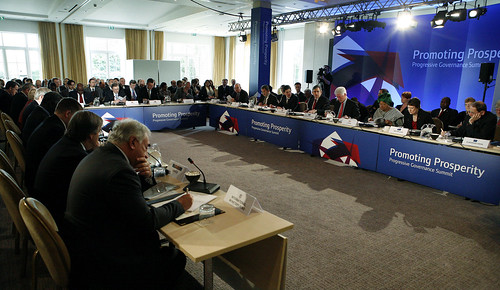
The summit was held at the Grove Hotel in Watford – which is more used to hosting the England football team and posh weddings. Locals – who were warned they would be searched before entering the hotel’s spa – seemed less than impressed at the interruption, though a few did manage to sneak in for a round of golf (though perhaps they were snipers in disguise).
And inside? We got a nice plug from Helen Clark, New Zealand’s PM, and from Africa’s first elected female head of state, Ellen Johnson-Sirleaf. Bill Clinton was also lucky enough to be collared by Global Dashboard’s Charlie Edwards on his way back from the lav, which I am sure was a highlight for both of them.
In discussion, two topics predominated. First, the global financial meltdown, with Kevin Rudd (surely the wonkiest head of state ever) fretting that ‘technology has got ahead of the regulatory environment,’ or in other words, men with computers are doing stuff with money that no-one, including the men themselves, really understands or can control.
A few leaders, Austria’s Alfred Gusenbauer among them, were calling for a World Finance Organisation to be created as an institutional big brother to the WTO (can you imagine the protests outside a WFO annual meeting?). But most were happy to settle for a revamped IMF to act as an ‘early warning system’ and for rapid action to, in the words of the head of the IMF, “disentangle the good and the bad banks”.
A global trade deal was also seen as a vital part of restoring confidence, with the WTO’s Pascal Lamy making it sound as if the conclusion of a ‘strong pro-development, pro-growth round’ was just around the corner. Peter Mandelson, who leads on trade for the Europeans, was a little less bullish, I thought.
Mandelson agreed that ‘night and day drilling’ into the detail of a proposed agreement was yielding results, but he argued that any further delay could be fatal for a deal. 2009 should be written-off, he said, due to a changing of the guard in the US in the first half of the year and in the European Commission in the second. Any agreement would have ‘turned to mush’ by 2010, he concluded.
It was a provocative point and a worrying one, given that 2009 is supposed to be the year the world does a deal on climate. How’s that going to work if everyone is too busy settling into new jobs to pay attention?
I thought the climate discussion was rather disappointing, despite Kevin Rudd’s attempt to muscle some shape into it. The climate paper was presented by Laurence Tubbiana (co-author Nick Stern had a more pressing engagement!) and she set out the same ‘seven elements for a global deal’ that Stern was promoting at Bali. It’s an unobjectionable list, but I am unconvinced by Tubbiana and Stern’s optimism that a deal will be easily struck.
Their framework, they argue, could “allow all countries to move quickly along what they see to be a responsible path”.
What is very striking here is how broadly basic understandings have already been established. Country-by-country we see targets being erected and measures being set by individual countries recognising their own responsibilities as they see international agreement being built. People seem to understand the arguments for action and collaboration on climate change much more readily than they do for international trade.
In the discussion, it was clear that leaders accepted the need for targets. After all, who doesn’t? But there seemed very little consensus on who should do what. It’s only when countries start to work out whether a global deal seems fair to them that we’ll really know whether or not it’ll be a rocky road to Copenhagen.
But climate felt like a little bit of a sideshow, with leaders keen to spend time on another scarcity problem – food. This is an area where my co-author, Alex Evans, is carrying out pioneering work (also see this summary) and it was clear how worried leaders are by rocketing prices.
But will that make any difference? In my part of our presentation (we’ll have text and perhaps some video later), I wondered whether food was going to be another ‘slow motion car crash’ like HIV/AIDS twenty years ago. Is it one of those problems that everyone can see coming, knows is going to be catastrophic, but is unable to do anything useful about? Time will tell.


