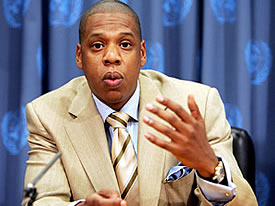
Further to yesterday’s news about UN Secretary-General Ban Ki-Moon’s big up to “my man Jay-Z”, we now have news of currency markets being shaken by rumours that Jay-Z is diversifying his FX holdings from dollars to euros. The BBC has more:
Wads of dollar bills are usually as much a part of rap videos as fast cars, diamond-encrusted jewellery and scantily-clad models. But in an apparent nod to the low value of the dollar, rapper Jay-Z’s new video Blue Magic features another currency. He is seen cruising the streets of New York in Bentleys and Rolls Royces (now owned by Germany’s Volkswagen and BMW) with a briefcase of 500 euro notes.
It’s sad that rap stars can no longer show their style with a good old $500 bills (featuring President McKinley) and now need to flash 500 euros (featuring some sort of suspension bridge). I don’t need the chairman of the Federal Reserve to tell me about the state of our economy. I just need Jay-Z, the new Alan Greenspan. I don’t blame Jay-Z. A stack of $50,000 in euros would equal $72,000 in U.S. currency. And you’d need 144 $500 bills to equal a stack of 100 500 euros. I don’t know if even Jay-Z has that large a money clip.
There seems to be a small revolt in progress at the UN over the ever-growing demand for its peacekeepers. There are currently more than 100,000 of them around the world, a record, and UN-watchers have been muttering darkly about “overstretch” for a while. But now there’s a new mood of frankness among senior officials too. Last week, Ban Ki-moon declared that sending a UN force into Somalia is not “a realistic and viable option” right now. That will have irritated Washington, which badly wants to the UN to go in to take some pressure off its Ethiopian allies, bogged down in Mogadishu.
This week, it’s been the turn of Ban’s Under-Secretary for Peacekeeping Jean-Marie Guehenno to tell it like it is. Reviewing the lack of hi-tech assets like helicopters available for the UN force in Darfur, he told the press that the mission there “may become a failure.” Guehenno has been blunt about such issues in the past. But these two statements, coming so close together, may foreshadow a growing fight over high-risk missions like Darfur and Somalia between a cautious UN Secretariat and those governments (most obviously the US and UK) that strongly favor these deployments.
So it’s worth noting the disconnect between these short-term warnings from the UN and some of the big picture thinking on peacekeeping that Gordon Brown laid out in his Mansion House speech on Monday. As Alex Evans pointed out in his review of the speech on this blog, Brown had much to say about the need for a “a new framework” to handle fragile states and peace operations. And much of it was absolutely right in theory: “Security Council peacekeeping resolutions and UN Envoys should make stablisation, reconstruction and development an equal priority”, for example. The problem is that you can’t make the theory work (or get onto reconstruction or development) if you don’t have the troops and helicopters you need to do stabilization.
In fairness, they know this in London. In a lecture on the EU as “Model Power Not Superpower” today, David Miliband had all the details on rotary wing aircraft:
EU countries have around 1,200 transport helicopters, yet only about 35 are deployed in Afghanistan. And EU member states haven’t provided any helicopters in Darfur despite the desperate need there.
Miliband went on to say that “increasing our capacity to put peacekeepers into the field – whether on UN, EU or NATO missions – is a crucial part of cooperation.” Again, this is absolutely right in principle. But even if the Europeans did have much greater capacity, would they be prepared to risk their assets and personnel in Somalia?
Er, no. Fewer than 2% of UN forces in Africa come from Europe. Give credit where it is due: the Norwegians and Swedes do want to send engineers to Darfur, and the EU is deploying (mainly French) soldiers to Chad alongside UN police. The UN will continue to have to bear the burden of new missions with troops from Africa and Asia. As that becomes ever more difficult and dangerous, the Secretariat may start to do what Bill Clinton told the UN to do after the last Somalia debacle in the 1990s: learn to say no.
Just spotted this Avaaz.org video from July, entitled ‘Stop the Clash’ [of civilisations]. It won this year’s Progressive Source award for best awareness-raising video. The soundtrack’s by DJ Spooky. It’s very good.
Benedict Brogan brings us this newsflash from his blog at DailyMail.co.uk:
Downing Street has announced that Alex Allan is to become the new chairman of the Joint Intelligence Committee. He is currently permanent secretary to the Ministry of Justice and has held a number of senior Whitehall posts, including PPS to John Major in the final days (he knows what the inside of a bunker looks like). He is also a committed Deadhead, who runs a website devoted to the oeuvre of the Grateful Dead. And as you would expect of a man who is ahead of the game on all things IT, he has his own website (which I suspect will be dismantled fairly shortly by the nice folk down Millbank way).