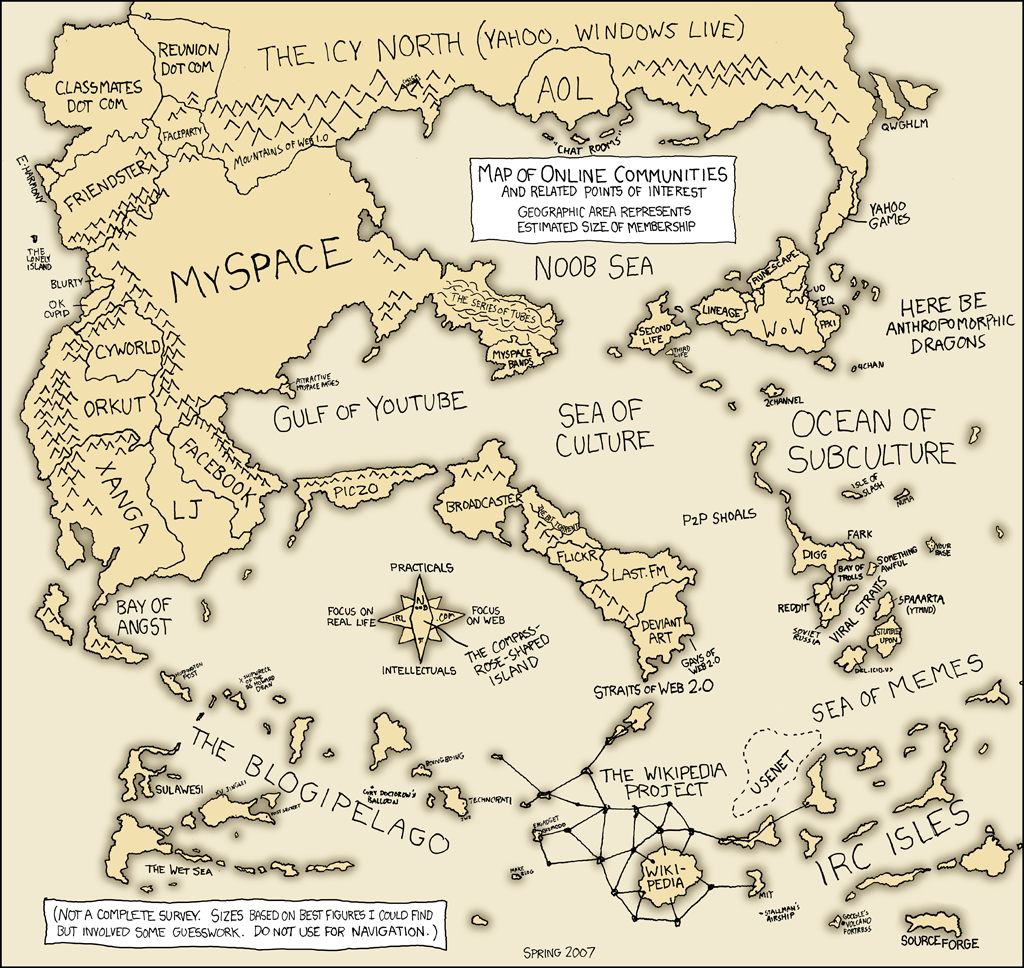
Here be anthropomorphic dragons…

Map of online communities and related points of interest…

Map of online communities and related points of interest…
If you haven’t already made the acquaitance of Michael Totten, then you should. Totten is an itinerant blogger who seems to wander around the Middle East on a semi-permanent basis, chatting to people and making YouTube videos. He’s financed in this fascinating endeavour by a small army of readers who donate through PayPal.
The results of his travels are often gripping, as in a recent post when he’s interviewing the police chief in Kirkuk in his office just as a suspect is brought in for questioning (a friend riding on a motorbike that the suspect was driving decided to start shooting into a crowd of people). Totten reaches for his video camera and starts taping on the spot…
P.S. Charlie Edwards, who runs Demos’s security program, has a story about a friend who was responsible for policing in Basra shortly after the invasion of Iraq. Early on in his tour, the Coalition Provisional Authority contracted out police training to private contractors, of whom he was one. In order to prove that they were being effective, they were told to define a range of Key Performance Indicators.
The British agonized over the complexities of policing and attempted to come up with a rough guide as to how they were doing. Meanwhile American contractors responded immediately: the police station should still have
all the chairs it was issued with; all the tables, all the guns, and all the padlocks; and no bullet holes in the external walls.
Which, when you stop to think about it, are actually pretty robust as indicators go…
US chat show presenter Jon Stewart’s recent interview with Senator John McCain (here) is interesting for what it says about US perceptions of statebuilding and peace support operations. Towards the end of an interview focused almost entirely on Iraq, Stewart gets one of the bigger audience rounds of applause of the night when he asks McCain with a rhetorical flourish:
How do you quell a civil war when it’s not your country?
Now, what’s really at issue in this debate is not so much the tactics of peacekeeping or peacemaking (though heaven knows the US has made an appalling hash of both in Iraq) nor even the exigencies of immediate post-conflict reconstruction (ditto), but a much longer term set of questions about what external actors can hope to achieve on governance in developing countries. What it really comes down to is this: can donors build effective states?
Wired.com has a piece today saying that:
The U.S. Army has ordered soldiers to stop posting to blogs or sending personal e-mail messages, without first clearing the content with a superior officer, Wired News has learned. The directive, issued April 19, is the sharpest restriction on troops’ online activities since the start of the Iraq war. And it could mean the end of military blogs, observers say.
Military officials have been wrestling for years with how to handle troops who publish blogs. Officers have weighed the need for wartime discretion against the opportunities for the public to personally connect with some of the most effective advocates for the operations in Afghanistan and Iraq — the troops themselves. The secret-keepers have generally won the argument, and the once-permissive atmosphere has slowly grown more tightly regulated. Soldier-bloggers have dropped offline as a result.
And they have a copy of the new rules, too. So much for muddy boots in the information battlespace (see David’s previous post) and the argument – proposed by winner of the US Army Information Operations Proponent (USIOP) essay-writing competition, Elizabeth Robbins – that:
Military blogs written by those in muddy boots… are a combat multiplier in the information domain… Commanders at every level must boldly accept risk in order to support the rewards and warfighting advantage that soldier-authors bring to the information battlespace.
The generation of Russians who are now in their twenties have a choice, a really defining choice for their country.
They can either go up the cul-de-sac of chauvinist nationalism, or they can seriously try and improve their country, its economy and its governance.
The Russian government is trying, through its management of Russian TV and through Kremlin-funded youth organizations like Nashi, to channel the nation’s attention away from the quality of its own political governance, and towards supposed threats or humiliations by the likes of Estonia, Georgia, Ukraine, the US, the EU, whoever.
They are trying to turn a war memorial in Estonia into, somehow, the defining issue for Russia’s youth. And for alot of Russia’s youth, even for well-educated young Russians, this IS the defining issue for them – how poor Russia is mistreated by Estonia, how poor Russia faces double standards in the EU, how poor Russia is stabbed in the back by the UK because we let Berezovsky live there, and so on.